
8 Automated Marketing Platforms for Gyms: Features, Pricing, Pros and Cons
September 19, 2026
A prospective member clicks your Instagram ad, fills out a form, and asks about your gym's beginner program.
You're teaching a class, so you don't see the inquiry until later that evening.
By then, the prospect may have contacted two other gyms.
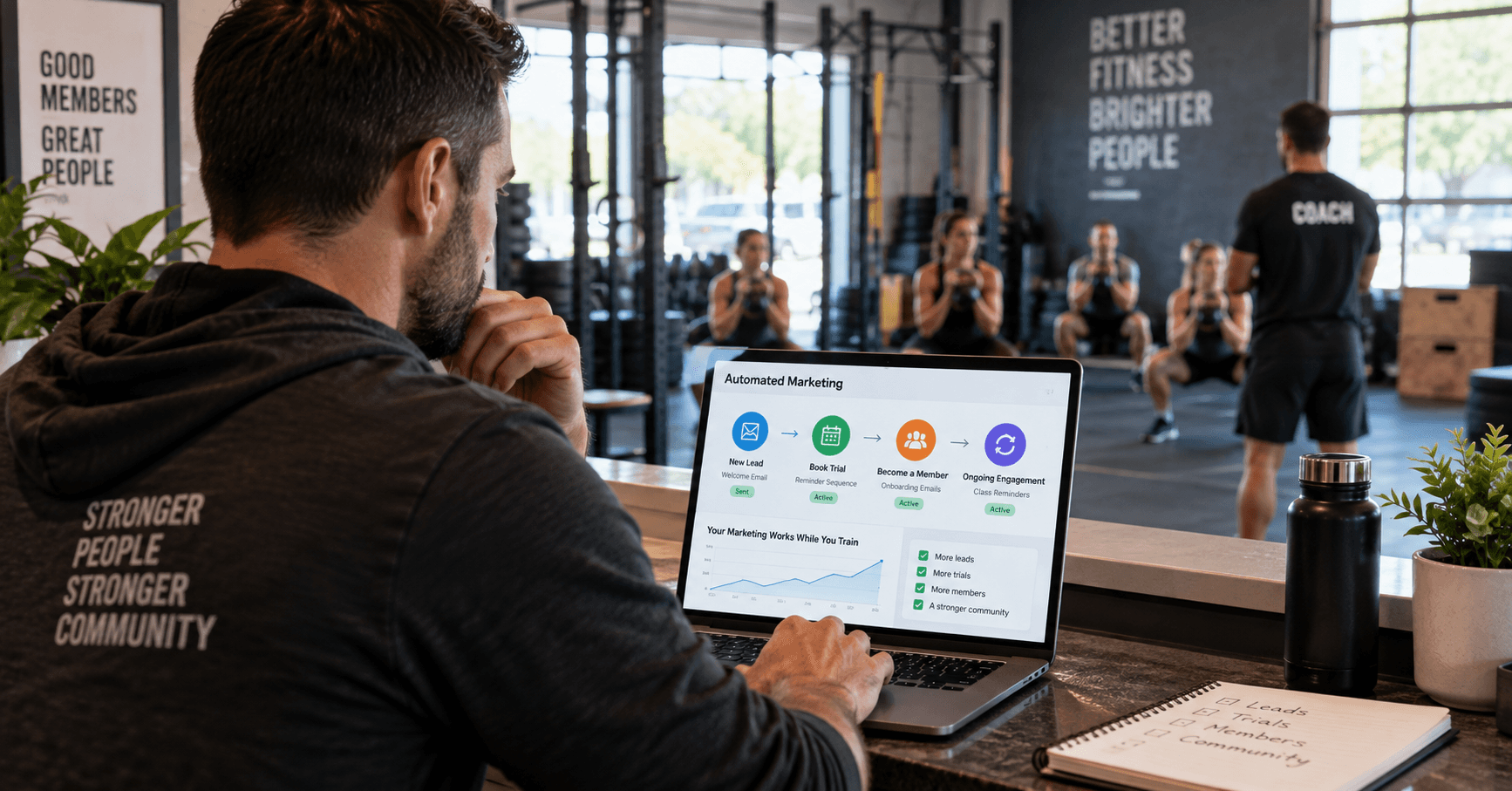
Now imagine that the lead automatically enters your CRM, receives a welcome message, gets a link to book a trial, and moves into a follow-up sequence if they haven't booked.
Your staff can see what happened, which messages were sent, and what needs personal attention.
That's what an automated marketing platform for gyms should help you accomplish.
These platforms can help you capture leads, run marketing campaigns, automate email and SMS follow-ups, manage sales pipelines, convert trial visitors into paying members, and reconnect with former members.
But not every platform takes the same approach.
Some are dedicated marketing and sales systems. Others combine marketing automation with gym management, memberships, attendance, and member engagement.
If you're looking for software to market your gym more effectively, the following eight platforms are worth comparing.
8 Automated Marketing Platforms for Gyms at a Glance
The table below compares the platforms by their marketing capabilities and the type of business each serves.
| Platform | Main marketing capabilities | Best fit to investigate |
|---|---|---|
| PushPress Grow | Lead capture, gym websites, CRM, automated email and SMS, sales pipelines, review generation | Independent gyms looking for a dedicated marketing and sales system |
| ClubOS | Lead management, automated sales follow-up, email and SMS campaigns, sales reporting | Gyms and fitness clubs that need structured sales and prospect management |
| Gymdesk | Lead capture, landing pages, marketing campaigns, CRM, automated follow-ups, referrals | Gyms wanting marketing automation integrated with membership management |
| WellnessLiving | Automated email and SMS campaigns, lead nurturing, reactivation, marketing analytics | Fitness studios wanting marketing connected to booking and client data |
| ABC Glofox | Fitness CRM, automated marketing journeys, lead follow-up, email and SMS, staff tasks | Boutique studios and growing fitness businesses |
| HighLevel | Landing pages, marketing funnels, CRM, email and SMS automation, appointment scheduling | Gyms wanting a customizable marketing platform rather than a gym-specific management system |
| Mindbody | Email and text marketing, automated customer communication, lead management, customer acquisition | Fitness and wellness businesses using the Mindbody ecosystem |
| Monstro-X | Marketing Suite, automated referrals, member communication, retention campaigns, engagement tools | Gyms and martial arts schools wanting marketing connected to the wider member experience |
These platforms don't all compete on exactly the same terms.
If you already have gym management software and only want a better lead generation and follow-up system, a dedicated marketing platform may make more sense.
If you want marketing to connect directly with memberships, attendance, referrals, and retention, an integrated gym platform deserves closer attention.
The detailed comparisons below explain what each platform offers and where you should look more closely before buying.
1. PushPress Grow
Best fit: Independent gyms that want a dedicated marketing and sales system connected to gym management.
PushPress Grow focuses on attracting prospects, following up with leads, and converting them into paying members.
It combines a gym website, CRM, automated communication, and sales pipeline tools.
Instead of collecting leads through one service and manually moving them into another, Grow is designed to connect the lead capture and follow-up process.
For example, someone who submits an inquiry through your website can enter an automated email or SMS sequence while their details appear in your sales pipeline.
Your staff can then track the prospect's progress from the initial inquiry to booking, trial attendance, and enrollment.
Main marketing features
| Feature | What it does for your gym |
|---|---|
| Website and lead capture | Collect inquiries and bring prospects into your sales process |
| Gym CRM | Keep lead information and communication organized |
| Email and SMS automation | Follow up with prospects through automated sequences |
| Sales pipeline | Track where leads are in the conversion process |
| Trial-to-member workflows | Support communication between a trial booking and membership purchase |
| Review generation | Help organize customer feedback and review requests |
| PushPress Core integration | Connect marketing information with the wider gym management system |
Pros and cons
| Pros | Cons |
|---|---|
| Strong focus on lead generation and membership sales | Grow adds to the cost of the wider PushPress setup |
| Connects website inquiries with the CRM and automated communication | Businesses using another management platform should check integration requirements |
| Helps staff track prospects through the sales pipeline | Owners who only need simple email campaigns may not require the full system |
| Includes review-generation and member communication features | Total cost depends on the products and package selected |
Pricing
PushPress Grow is currently advertised at $329 per month as an add-on to PushPress Core. Bundled options are also available.
Confirm the full price of your intended setup, including any additional services or communication charges.
Why consider PushPress Grow?
If your biggest challenge is turning website visitors and advertising leads into booked trials and memberships, Grow offers a marketing-focused system built around that process.
2. ClubOS
Best fit: Gyms and fitness clubs that want structured lead management, sales follow-up, and marketing automation.
ClubOS is a fitness-focused CRM and sales engagement platform.
Its marketing tools help gyms capture leads, organize follow-up activities, run email and text campaigns, and measure sales performance.
Imagine your gym receives inquiries from its website, Facebook campaigns, referrals, and walk-ins.
Without a central CRM, those contacts can end up scattered across spreadsheets, inboxes, and staff members' phones.
ClubOS helps bring those prospects into a more organized sales process.
It can also support automated communication and staff follow-up, allowing your team to focus on the conversations that need personal attention.
Main marketing features
| Feature | What it does for your gym |
|---|---|
| Lead capture | Collect and organize prospective member information |
| Gym CRM | Track leads and their movement through the sales process |
| Marketing automation | Automate relevant prospect and member communication |
| Email campaigns | Send targeted marketing messages |
| SMS campaigns | Reach prospects and members through text |
| Sales follow-up | Help staff manage ongoing prospect communication |
| Sales reporting | Review sales activity and conversion performance |
Pros and cons
| Pros | Cons |
|---|---|
| Designed around the sales and marketing needs of fitness businesses | Owners should verify integration with their existing gym management software |
| Provides a central system for lead tracking and follow-up | Pricing is not presented as a simple universal package |
| Includes automated email and SMS capabilities | Smaller gyms may not need the full sales management system |
| Supports staff accountability through structured prospect management | Advanced marketing requirements should be confirmed during a demo |
Pricing
Contact ClubOS for a quote based on your business requirements.
Why consider ClubOS?
ClubOS is worth investigating if your gym already receives a reasonable number of leads but struggles to organize sales conversations and follow-up.
3. Gymdesk
Best fit: Independent gyms and martial arts schools that want lead generation and marketing automation within their gym management software.
Gymdesk combines gym management with marketing tools designed to help owners attract prospects, follow up with leads, and communicate with members.
Its marketing features include lead capture forms, landing pages, CRM functionality, email and SMS communication, automated workflows, and referral management.
The advantage of this approach is that marketing information can connect with the activity taking place inside the gym.
For example, a prospect can submit a form, receive an automated follow-up, book a trial, and move into the next appropriate workflow.
Once they become a member, communication can respond to relevant membership and attendance events.
Main marketing features
| Feature | What it does for your gym |
|---|---|
| Landing pages and lead forms | Capture prospects from your website and marketing campaigns |
| Lead management | Track inquiries, conversations, bookings, and enrollment |
| Email marketing | Send newsletters, promotions, and targeted campaigns |
| SMS marketing | Send automated or manual text communication |
| Marketing workflows | Automate lead nurture, trial follow-up, and other campaigns |
| Audience segmentation | Target people based on relevant member or prospect information |
| Referral management | Track member referrals and applicable rewards |
| Marketing reporting | Review lead sources and marketing outcomes |
Pros and cons
| Pros | Cons |
|---|---|
| Marketing connects directly with gym management data | Owners looking for advanced advertising campaign management may need additional tools |
| Includes landing pages and lead capture forms | Messaging usage and any applicable charges should be reviewed |
| Supports lead generation, sales follow-up, and member communication | Switching from another gym management platform may require data migration |
| Automation is included across its advertised plans | Businesses using a separate specialized CRM should compare integration requirements |
Pricing
Gymdesk currently advertises plans starting at $75 per month.
Pricing depends on business size and applicable usage requirements.
Why consider Gymdesk?
If you want to collect leads, automate follow-ups, and manage your gym from one system, Gymdesk provides a way to connect those activities without relying entirely on separate marketing tools.
Explore Gymdesk Marketing Software
4. WellnessLiving
Best fit: Fitness studios and wellness businesses that want automated marketing campaigns connected to client bookings and activity.
WellnessLiving offers a Marketing Suite designed to automate communication across the customer journey.
Its platform combines email and SMS campaigns with client and business information.
For example, a studio can use automated campaigns to follow up with new leads, communicate with active clients, and reconnect with people who have stopped attending.
WellnessLiving also offers broader business management features, including booking, memberships, payments, and client management.
Main marketing features
| Feature | What it does for your gym |
|---|---|
| Automated email marketing | Send targeted campaigns and follow-up sequences |
| Automated SMS marketing | Deliver text-based marketing and communication |
| Lead nurturing | Follow up with prospective members |
| Marketing templates | Provide starting points for common campaign types |
| Client segmentation | Use relevant customer information to target communication |
| Win-back campaigns | Reconnect with former or inactive clients |
| Marketing analytics | Review campaign activity and outcomes |
Pros and cons
| Pros | Cons |
|---|---|
| Marketing automation is designed for fitness and wellness businesses | Owners should verify the cost and availability of the Marketing Suite |
| Can use client and booking information to inform campaigns | Businesses wanting only standalone marketing software may not need the broader platform |
| Supports lead nurturing and reactivation | Switching business management systems may involve operational changes |
| Includes prebuilt marketing workflows | Highly customized marketing requirements should be tested during a demo |
Pricing
Contact WellnessLiving to confirm the current subscription options and the cost of the Marketing Suite.
Why consider WellnessLiving?
If you operate a fitness studio and want email and SMS marketing connected to customer activity, WellnessLiving offers an integrated approach.
Explore WellnessLiving Marketing Suite
5. ABC Glofox
Best fit: Boutique fitness studios and growing gym businesses that want CRM and marketing automation connected to the member lifecycle.
ABC Glofox provides fitness business management software with marketing and customer engagement capabilities.
Its XLerate platform focuses on automating communication across different stages of the customer journey.
That includes lead follow-up, onboarding, membership communication, and retention-related campaigns.
For a studio running several programs or managing multiple locations, this approach can help create more consistent communication while still allowing staff to manage individual customer relationships.
Main marketing features
| Feature | What it does for your gym |
|---|---|
| Fitness CRM | Organize prospects and customer information |
| Automated marketing journeys | Deliver communication based on relevant customer events |
| Email and SMS campaigns | Reach leads and members through multiple channels |
| Lead follow-up | Support prospect communication and conversion |
| Staff task automation | Create follow-up activities for your team |
| Member segmentation | Tailor communication to different customer groups |
| Lifecycle marketing | Support onboarding, engagement, and reactivation |
Pros and cons
| Pros | Cons |
|---|---|
| Marketing tools connect with the wider gym and studio platform | XLerate is not available on every Glofox subscription |
| Supports lead conversion and ongoing customer engagement | Owners should confirm the total cost of their preferred package |
| Includes automated workflows and staff follow-up tools | A small gym may not need the full scope of the wider platform |
| Provides tools for businesses managing multiple programs and locations | Businesses using another management system should review migration requirements |
Pricing
Glofox offers different plans and product packages.
Confirm whether XLerate is included in your proposed subscription or requires an additional purchase.
Why consider ABC Glofox?
If you're looking for marketing automation that connects sales, booking, membership activity, and ongoing customer engagement, Glofox provides an integrated option.
6. HighLevel
Best fit: Gym owners who want a customizable marketing CRM and are comfortable building or managing their own marketing workflows.
HighLevel is a general-purpose marketing and CRM platform rather than software built exclusively for gyms.
It offers tools for landing pages, sales funnels, lead management, email and SMS communication, appointment booking, and workflow automation.
A gym could use HighLevel to capture leads from advertising campaigns, send follow-up messages, manage introductory appointment bookings, and track prospects through a sales pipeline.
Because the system isn't limited to fitness businesses, it can also appeal to owners who want to create more customized marketing campaigns.
However, that flexibility comes with a trade-off.
You'll need to make sure the workflows match how your gym actually operates.
Main marketing features
| Feature | What it does for your gym |
|---|---|
| Landing pages and funnels | Build pages for lead generation campaigns |
| CRM and sales pipeline | Organize prospects and track sales opportunities |
| Email marketing | Send automated campaigns and follow-up sequences |
| SMS marketing | Communicate with leads through text |
| Appointment scheduling | Allow prospects to book consultations and trials |
| Workflow automation | Build multistep marketing processes |
| Campaign reporting | Monitor marketing and sales activity |
Pros and cons
| Pros | Cons |
|---|---|
| Offers flexible marketing funnels and CRM workflows | Not a dedicated gym membership management platform |
| Can support multiple lead generation channels | Gym-specific workflows may require more initial setup |
| Includes landing pages, communication, and appointment tools | Attendance and membership-based automation may require integrations |
| Useful for businesses that want greater control over their marketing system | Messaging, usage, and additional services can affect total cost |
Pricing
HighLevel offers multiple subscription options.
Check its current pricing and calculate the full cost of your intended setup, including communication usage and any additional services.
Why consider HighLevel?
If you want a marketing-focused system and already have gym management software you're happy with, HighLevel may be worth investigating as a separate CRM and campaign automation platform.
7. Mindbody
Best fit: Fitness and wellness businesses looking for automated marketing alongside booking, client management, and customer acquisition tools.
Mindbody combines fitness business management with marketing and customer communication tools.
Its marketing capabilities include automated email and text campaigns, customer engagement tools, and lead management.
Mindbody also offers a consumer-facing marketplace where people can discover participating fitness and wellness businesses.
That gives owners another customer acquisition channel to consider alongside their own website, referrals, and advertising campaigns.
Main marketing features
| Feature | What it does for your gym |
|---|---|
| Email marketing | Send campaigns and business updates |
| Text marketing | Communicate with prospects and clients |
| Automated customer journeys | Support communication at different customer stages |
| Lead management | Track prospective customers and sales activity |
| Client segmentation | Tailor communication to relevant customer groups |
| Mindbody marketplace | Provide an additional discovery and booking channel |
| Business reporting | Review relevant customer and business performance |
Pros and cons
| Pros | Cons |
|---|---|
| Connects marketing with booking and client management | Advanced marketing capabilities may require higher-tier plans |
| Offers a broader customer discovery ecosystem | The full package may be more than a small gym requires |
| Supports different fitness and wellness business models | Owners should verify communication allowances and add-on costs |
| Includes tools for both acquisition and ongoing client communication | Businesses focused only on standalone marketing may not need the wider system |
Pricing
Mindbody offers different subscription tiers.
Confirm which plan includes the automated marketing capabilities you need and whether any additional charges apply.
Why consider Mindbody?
For gyms and studios that want marketing, booking, and customer management within the same ecosystem, Mindbody offers a broader platform to evaluate.
8. Monstro-X
Best fit: Gyms, martial arts schools, and group-class businesses that want marketing, referrals, retention, and member engagement connected to their management software.
Monstro-X takes a broader approach to gym growth by combining marketing-related features with membership management and member engagement tools.
Its platform includes a Marketing Suite, automated referrals, member communication, automated reminders, attendance tracking, and retention-related workflows.
For gym owners, this creates opportunities to connect marketing activity with what happens after someone joins.
For example, referrals can become part of your member engagement process rather than depending entirely on staff remembering to ask people to bring a friend.
Attendance and engagement information can also help identify members who may need follow-up.
That can make Monstro-X relevant to businesses looking to grow through a combination of new-member acquisition, referrals, engagement, and retention.
Main marketing features
| Feature | What it does for your gym |
|---|---|
| Marketing Suite | Provides marketing functionality within the broader platform |
| Automated referral system | Helps manage referrals through member codes and applicable rewards |
| Member communication | Supports communication with your member base |
| Push notifications and reminders | Helps keep members informed and engaged |
| Retention campaigns | Supports follow-up connected to member activity |
| Attendance and engagement information | Helps identify members who may need attention |
| Rewards and achievements | Supports member engagement and milestone recognition |
Pros and cons
| Pros | Cons |
|---|---|
| Connects marketing-related activity with membership and engagement data | Owners seeking a standalone advertising or email marketing platform may not need the full management system |
| Includes automated referrals and retention-related features | Confirm which lead acquisition and marketing campaign capabilities are available in the Marketing Suite |
| Offers tools relevant to martial arts schools and group-class businesses | Marketing features and usage allowances should be checked against the chosen plan |
| Combines marketing, referrals, engagement, and daily membership operations | Businesses with an established CRM should evaluate integration or migration requirements |
Pricing
Monstro-X currently advertises the following monthly plans:
| Plan | Advertised price |
|---|---|
| Free | $0 |
| Basic | $159/month |
| Growth | $299/month |
The free plan is intended for eligible businesses with fewer than 25 members.
Additional charges may apply according to plan and usage.
Check the Monstro-X pricing page for current details and confirm which marketing capabilities are included in your intended package.
Why consider Monstro-X?
Monstro-X is worth investigating if you want marketing to extend beyond lead acquisition into referrals, ongoing member communication, engagement, and retention.
If your main requirement is a sophisticated standalone advertising funnel or a specialized sales CRM, compare those capabilities directly before choosing a platform.
Which Type of Gym Marketing Platform Should You Choose?
Now that you've seen the platforms, the next step is figuring out which type of system fits your business.
The key distinction is between dedicated marketing software and marketing functionality built into a gym management platform.
Choose a dedicated marketing platform when lead generation is your main priority
Imagine you're spending $2,000 a month on advertising.
Your campaigns are generating inquiries, but you have no reliable way to track which leads have been contacted, which prospects booked a trial, or how many became paying members.
Your immediate priority is improving the sales and marketing process.
A marketing-focused CRM may be worth investigating for its lead capture, automated communication, appointment scheduling, and sales pipeline capabilities.
Platforms such as PushPress Grow, ClubOS, and HighLevel offer different approaches to those requirements.
Choose an integrated platform when you want marketing connected to membership data
Now imagine your gym has a reasonable sales process, but the owner uses one system for marketing and another for managing members.
Your marketing tool doesn't automatically know when a lead joins.
Your staff manually removes new members from promotional campaigns.
Attendance-related follow-up requires exporting a spreadsheet every week.
An integrated platform can reduce some of that disconnected work.
Gymdesk, WellnessLiving, Glofox, Mindbody, and Monstro-X are examples of platforms worth evaluating when you want marketing to connect with wider business operations.
Choose based on your actual workflow, not the length of the feature list
A platform can offer dozens of marketing features and still be a poor match for the process your gym needs.
Before making a decision, write down your biggest marketing problems.
Are you struggling to generate inquiries?
Do leads go unanswered?
Are people booking trials but not attending?
Are you failing to follow up after the first class?
Do you want to run referral campaigns?
Are former members sitting in your database without a reactivation process?
The answers should guide which platform capabilities you examine first.
What Features Should an Automated Marketing Platform for Gyms Have?

The platforms above offer different combinations of marketing tools.
To compare them properly, start with the features that directly affect your ability to attract prospects and convert them into members.
1. Lead capture and landing pages
Your marketing campaigns need somewhere to send interested prospects.
A good platform should help you capture inquiries from relevant sources, such as website forms, landing pages, advertising campaigns, or appointment bookings.
If you're running a paid advertisement for a six-week beginner program, you should be able to identify leads who came through that campaign.
That makes it easier to evaluate the results of your marketing rather than treating every inquiry as though it came from the same place.
2. Gym CRM and sales pipeline
A CRM helps you keep track of prospective members.
Your staff should be able to see who has inquired, what program they're interested in, when they were contacted, and what needs to happen next.
A simple gym sales pipeline might look like this:
New lead → Contacted → Trial booked → Trial attended → Membership offered → Joined
A CRM becomes especially useful when several employees handle sales and follow-up.
Instead of relying on memory, everyone can see the status of each opportunity.
3. Automated email marketing
Email marketing can support several stages of your gym's sales process.
You can send introductory information, program details, trial preparation messages, newsletters, and relevant promotional campaigns.
Look for the ability to create automated sequences, segment contacts, and stop campaigns when someone takes the intended action.
A new member should not continue receiving the same introductory offer they already purchased.
4. SMS marketing and two-way communication
Text messages can be useful for shorter communication, such as appointment reminders and relevant follow-up.
But the ability to send messages isn't enough.
Can a prospect reply?
Will the reply appear in a shared inbox?
Can a staff member take over?
Does the platform keep the conversation history?
These details matter because joining a gym often involves questions that an automated sequence cannot answer properly.
5. Automated workflows and lead nurturing
A useful workflow responds to what a prospect actually does.
For example:
- A new inquiry triggers an acknowledgement.
- The prospect receives a trial booking link.
- If they book, the initial lead sequence stops.
- The appointment reminder workflow begins.
- If they attend, a trial follow-up sequence starts.
- If they join, they leave the sales workflow.
The important feature is the ability to move people between stages without continuing to send irrelevant messages.
6. Marketing campaign reporting
A platform should help you understand what happened after someone entered your marketing system.
Useful information includes:
- Number of leads generated
- Lead source
- Cost per lead, when advertising cost data is available
- Appointment booking rate
- Trial attendance rate
- Lead-to-member conversion rate
- Cost per new member
- Campaign-generated membership revenue, where attribution is available
Email opens and clicks can provide additional context, but they shouldn't be the only numbers you examine.
Your gym needs to know whether marketing activity is producing actual memberships.
7. Integration with your existing software
If you're buying a standalone marketing system, verify how it connects with your current gym management platform.
Can it identify when a prospect buys a membership?
Can it stop sales campaigns automatically?
Can it access relevant booking or attendance events?
Will your staff need to move information between systems manually?
The answers determine how much work the software actually removes.
5 Gym Marketing Campaigns You Can Automate
Once you've chosen a platform, start with campaigns that address recognizable gaps in your sales process.
You don't need to automate everything immediately.
These five campaigns provide a useful starting point.
1. New lead follow-up campaign
Goal: Turn an initial inquiry into a conversation or trial booking.
Trigger: Someone submits a lead form.
Example workflow:
- Send an immediate acknowledgement.
- Provide a link to book an introductory session.
- Create a staff follow-up task if the prospect hasn't replied or booked.
- Send appropriate additional information when needed.
- Stop the campaign when the prospect books, joins, declines, or opts out.
Example message:
"Hey Mike, thanks for reaching out to Westside Strength. I saw you're interested in our beginner program. You can grab an intro time here, or reply to this text if you have a question first. — Chris"
The message should sound like it came from your gym, not a generic marketing template.
2. Trial booking and reminder campaign
Goal: Help prospects attend their scheduled introductory session.
Trigger: Someone books a trial.
Example workflow:
- Send an appointment confirmation.
- Share the gym address and preparation information.
- Send an appropriate reminder before the trial.
- Stop reminders when the appointment is completed or canceled.
- Start the correct follow-up based on the appointment outcome.
A trial reminder should make the visit easier.
It doesn't need to be another sales pitch.
3. Trial-to-membership campaign
Goal: Help interested trial visitors understand the next step toward becoming members.
Trigger: A prospect attends an introductory session.
Example workflow:
- Send a thank-you message.
- Provide relevant membership information.
- Create a personal follow-up task.
- Answer outstanding questions.
- Stop the campaign when the prospect joins or declines.
A prospect who says, "I need to think about it," doesn't necessarily need five more discount messages.
They may need help understanding the schedule, choosing a membership, or deciding whether the gym is a good fit.
Use automation to support that conversation.
4. Former-lead reactivation campaign
Goal: Reconnect with eligible prospects who showed interest but never enrolled.
Trigger: A lead has remained inactive for a defined period.
You might have prospects in your database who asked about membership several months ago but never booked a trial.
Before sending a campaign, consider their previous communication and preferences.
Someone who explicitly declined further contact should not be treated the same as someone who asked you to follow up later.
Example message:
"Hey Sarah, you reached out a while back about our beginner classes. We've added some new evening sessions, so I thought I'd check whether you're still interested. Happy to send over the updated schedule if that helps."
This approach gives the prospect a reason to respond without assuming they're ready to purchase.
5. Referral marketing campaign
Goal: Encourage eligible existing members to introduce friends or family to your gym.
Trigger: A suitable member milestone, campaign launch, or referral invitation.
A referral campaign might provide members with a personal referral link or code, explain the offer, and track completed referrals.
If your platform supports referral rewards, you can also manage the associated incentives.
However, referral campaigns should not depend entirely on automated messages.
A coach personally inviting a member to bring a friend can still be an important part of the process.
Automation helps make the process easier to track and repeat.
How to Measure the Results of Your Gym Marketing Automation
Automating marketing doesn't automatically make it effective.
You still need to know whether your campaigns are generating useful business results.
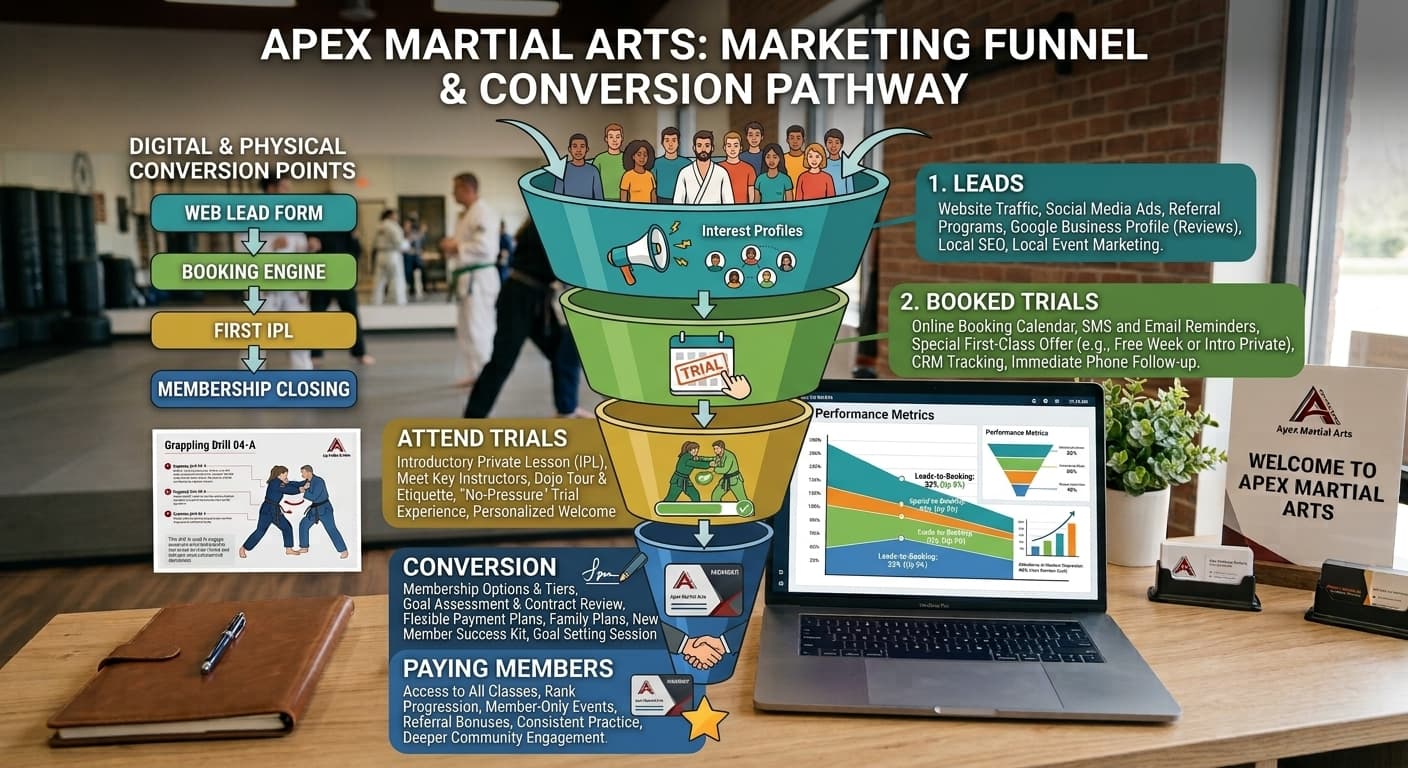
Start with the path someone takes from becoming a lead to purchasing a membership.
Leads → Contacted → Trials booked → Trials attended → New memberships
Track the number of people reaching each stage.
For example, consider this hypothetical monthly marketing report:
| Marketing metric | Example result |
|---|---|
| Advertising spend | $1,000 |
| Leads generated | 100 |
| Trials booked | 40 |
| Trials attended | 30 |
| New memberships | 15 |
In this example:
Cost per lead: $1,000 ÷ 100 = $10
Lead-to-member conversion rate: 15 ÷ 100 × 100 = 15%
Cost per new member: $1,000 ÷ 15 = approximately $66.67
These are illustrative numbers, not industry benchmarks.
They show why looking at lead volume alone can be misleading.
You might generate 100 leads but discover that only 30 attend a trial.
That tells you something important about your sales process.
The next step may be improving lead qualification, trial scheduling, appointment reminders, or the initial customer experience rather than simply increasing advertising spend.
Your marketing platform should make those gaps easier to identify.
Common Mistakes to Avoid When Automating Gym Marketing
Choosing software before defining your marketing process
Don't start by asking which platform has the most automation features.
Start by identifying how your gym attracts leads, responds to inquiries, books trials, and converts prospects into members.
Once you understand that process, you'll know which features you actually need.
Sending too many automated messages
More follow-up isn't always better.
A prospect who receives several texts and emails within a short period may become less interested rather than more engaged.
Every message should have a clear purpose.
Remove unnecessary communication and respect people's preferences.
Failing to stop campaigns when someone converts
Imagine joining a gym on Monday and receiving another introductory membership offer on Wednesday.
This happens when marketing workflows don't respond properly to changes in prospect status.
Make sure campaigns stop or change when someone books a trial, joins, cancels, or opts out.
Ignoring staff follow-up
Automated messages cannot answer every question.
A prospect might want to discuss a membership option, ask about beginner classes, or explain why they missed an appointment.
Make sure your staff knows when to take over the conversation.
Automation should help your team recognize and respond to those situations.
Measuring leads instead of paying members
A campaign that generates 200 low-intent inquiries isn't necessarily more effective than one that generates 40 qualified prospects.
Track the complete journey from inquiry to membership.
If your platform supports revenue attribution, use it to understand which marketing efforts contribute to sales.
Frequently Asked Questions
What is an automated marketing platform for gyms?
An automated marketing platform for gyms is software that helps owners capture leads, manage marketing campaigns, automate email and SMS follow-ups, track prospects, and support membership sales.
Some platforms focus primarily on marketing and sales. Others combine those capabilities with gym management, attendance, and member engagement tools.
What marketing automation software do gyms use?
Gyms use a range of platforms, including PushPress Grow, ClubOS, Gymdesk, WellnessLiving, ABC Glofox, HighLevel, Mindbody, and Monstro-X.
The appropriate choice depends on whether the gym needs a standalone marketing CRM, an integrated management platform, or particular features such as lead capture, sales pipelines, referrals, and retention campaigns.
Can marketing automation help gyms generate leads?
Marketing automation can support lead generation through landing pages, capture forms, campaign follow-up, and referral workflows.
However, the platform itself doesn't automatically create demand.
Your marketing offer, advertising, website, local visibility, and referral strategy still influence how many prospects discover your gym.
Automation helps you capture, organize, and follow up with those opportunities.
How much does automated gym marketing software cost?
Pricing varies by platform, subscription tier, business size, communication usage, and the features required.
Some marketing systems are sold separately from gym management software, while others include marketing tools within a broader subscription.
Compare the total cost of the setup you need, including SMS, email usage, integrations, additional locations, and other applicable charges.
Do I need a marketing platform if I already use gym management software?
Not necessarily.
First, check whether your current management software already includes the lead capture, CRM, campaign automation, and reporting features you need.
If those capabilities are missing or insufficient, a dedicated marketing platform may help.
Before purchasing another system, verify how it will connect with your existing member and booking information.
What marketing campaigns should a gym automate first?
Start with the campaigns that address your biggest operational gaps.
For many gyms, that means new-lead follow-up, trial booking reminders, trial-to-membership follow-up, and reactivation of eligible former leads.
Once those workflows are functioning properly, you can expand into referral campaigns, member onboarding, and other marketing activities.
Final Thoughts: Choose a Platform That Solves Your Marketing Problem
If you're looking for an automated marketing platform for your gym, start by identifying what you actually want it to accomplish.
Do you need more leads?
Do you need a better way to follow up with existing inquiries?
Are you looking for a CRM that keeps your sales team organized?
Do you want automated email and SMS campaigns?
Or do you want marketing connected to memberships, referrals, and long-term member engagement?
Those are different requirements, and they don't all call for the same software.
Compare platforms based on the marketing process your gym needs, the tools you already use, and the total cost of the setup.
Most importantly, remember that automation works best when it supports a clear sales and marketing process.
The platform can capture the inquiry, send the reminder, and keep your staff organized.
Your team still needs to give prospects a reason to join.
Sources and References
- PushPress Grow – Gym Marketing Automation
- ClubOS – Gym CRM and Marketing Software
- Gymdesk – Gym Marketing Software
- Gymdesk – Marketing and Workflow Automation
- WellnessLiving – Marketing Suite
- ABC Glofox – XLerate Fitness CRM
- HighLevel – Marketing and CRM Platform
- Mindbody – Fitness Business Software
- Monstro-X – Gym Management and Marketing Features
- Monstro-X – Pricing