
5 Reasons "Cheap" Social Leads Cost Your Gym Thousands
July 15, 2026
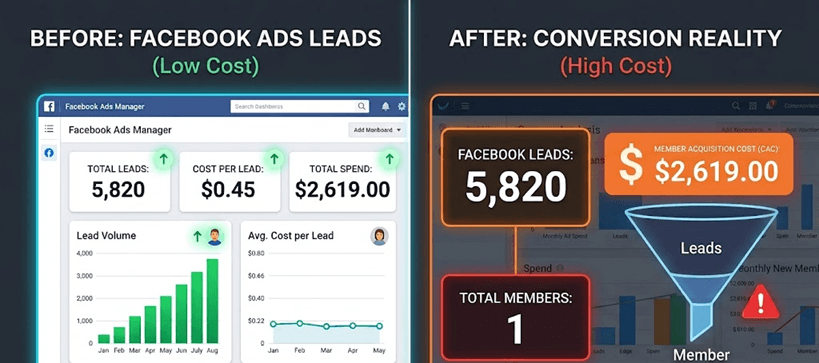
Have you ever looked at your Facebook or Instagram ads and thought, "Wow, I'm getting leads for just $2 each. This campaign is crushing it." It feels like a huge win. But then reality kicks in.
Your sales team starts calling those leads, and most don't answer. The ones who do answer say they were "just curious." Some never book a consultation. Others come in for a free trial and disappear forever.
At the end of the month, you've collected hundreds of leads—but only a handful of new members. Sound familiar?
Here's the uncomfortable truth: cheap leads can become the most expensive leads your gym ever buys. Today, we're breaking down five reasons why chasing the lowest cost per lead could be quietly costing your gym thousands of dollars—and what you should focus on instead.
Reason #1: They Drain Your Sales Team’s Time
Let's start with the biggest hidden cost: time.
Most gym owners only look at what they paid for the lead (maybe it's $3 or $5). But they rarely calculate how much it costs to follow up with that lead. Think about the process:
- Someone fills out a form.
- Your staff calls them. No answer.
- They send a text. They send an email.
- They call again the next day. They leave a voicemail.
- They try again next week.
Multiply that by hundreds of people who were never serious about joining in the first place. Your sales team spends hours chasing people who opted in because they wanted a free workout, a giveaway, or simply clicked an ad without much thought.
Now imagine if those same hours were spent talking to people who were actually looking for a gym. Your employees have limited time and energy. Every minute spent pursuing unqualified prospects is a minute they're not spending closing motivated buyers.
Reason #2: They Destroy Your True Conversion Rate
Here's a simple comparison to show why experienced marketers don't obsess over cost-per-lead:
- Gym A generates 200 leads for $2 each. (Total Spend: $400)
- Gym B generates 50 leads for $10 each. (Total Spend: $500)
At first glance, Gym A looks like the winner. More leads for less money. But let's look deeper.
- If Gym A converts only 2% of those leads, they gain 4 new members.
- If Gym B converts 20% of those leads, they gain 10 new members.
Suddenly, the more expensive campaign produces more than double the number of paying customers. They focus on cost per acquisition—how much it actually costs to acquire a paying member. A cheap lead that never joins your gym isn't cheap at all. It's just another name on a spreadsheet.
Reason #3: They Burn Out Your Staff
Imagine making fifty phone calls in a single day:
- Forty-five people don't answer.
- Three gave fake numbers.
- One says they only wanted the free water bottle.
- One says they don't even remember filling out the form.
Now imagine your team repeating that every single week. Eventually, your staff loses motivation. Their energy drops. Their follow-up becomes less enthusiastic.
And here's the dangerous part: when good leads finally come in, they're treated with the same skepticism because your team has become conditioned to expect rejection. A motivated sales team is one of the most valuable assets a gym can have. Protecting that motivation is worth far more than saving a few dollars per lead.
Reason #4: They Attract Bargain Hunters, Not Lifers
Let's talk about the offers themselves. Many low-cost lead campaigns rely on promotions like:
- "Free 30-Day Membership."
- "Join for just $1."
- "Win free personal training."
These offers definitely generate attention. But who are they attracting? Usually, people looking for the biggest discount—not people committed to changing their lifestyle.
When price becomes your biggest selling point, price also becomes the reason people leave. The moment another gym offers a slightly better deal, they're gone.
Long-term members usually join because they believe in your coaching, your community, your results, and your environment. Those are the members who stay for months or even years. They're also the ones who purchase personal training, nutrition coaching, recovery services, and refer their friends. The lifetime value of one committed member can be worth thousands of dollars. That's who your marketing should attract.
Reason #5: They Create a Dangerous Illusion of Success
This is probably the biggest trap of all. Marketing dashboards love vanity metrics: Two hundred leads. Three hundred clicks. Thousands of impressions. Those numbers feel exciting. But none of them pay the bills. Volume without quality is just noise. Instead, ask better questions:
- How many leads booked a consultation?
- How many actually showed up?
- How many signed a membership agreement?
- How many are still members six months later?
Those numbers tell the real story. Because at the end of the day, your business doesn't survive on leads. It survives on recurring memberships.
The Bottom Line
Start by defining what a quality lead actually looks like. Instead of targeting everyone in your city, target people who are actively interested in fitness, weight loss, strength training, or improving their health.
Create ads that speak directly to their goals rather than simply offering the cheapest promotion. Show client success stories. Highlight transformations. Introduce your coaches. Share your gym's culture.
A cheap lead isn't automatically a good lead. If that lead never answers the phone, never visits your gym, never buys a membership, and never becomes a long-term customer, it wasn't a bargain. It was an expense disguised as a victory.
The gyms that consistently grow aren't obsessed with generating the cheapest leads. They're obsessed with attracting the right people, delivering a great experience, and turning first-time visitors into lifelong members.