
Here’s How to Increase Gym Membership Retention

August 19, 2026
You sign up 25 new members.
It feels like a good month.
Then you look at the active member count and realize you only grew by six.
The other 19 did not disappear overnight. Some long-term members canceled. A few new members stopped showing up. Someone froze their membership. Someone else had a failed payment and nobody followed up.
You were adding members at the front while losing them quietly in the background.
That is the retention problem.
And it is one of the easiest problems to underestimate because a gym can feel busy while standing still.
The Health & Fitness Association's 2025 benchmarking report found an average 66.4% annual member retention rate among participating fitness businesses. The research covered 175 companies representing more than 17,000 facilities across 27 countries.1
There is also a broader business reason to take retention seriously. Harvard Business Review notes that, depending on the industry and study, acquiring a new customer can cost five to 25 times more than retaining an existing one.2
That is not a gym-specific benchmark, but the basic economics still matter.
If you keep replacing members you already worked hard to acquire, your marketing has to run faster just to keep the business in the same place.
So how do you increase gym membership retention?
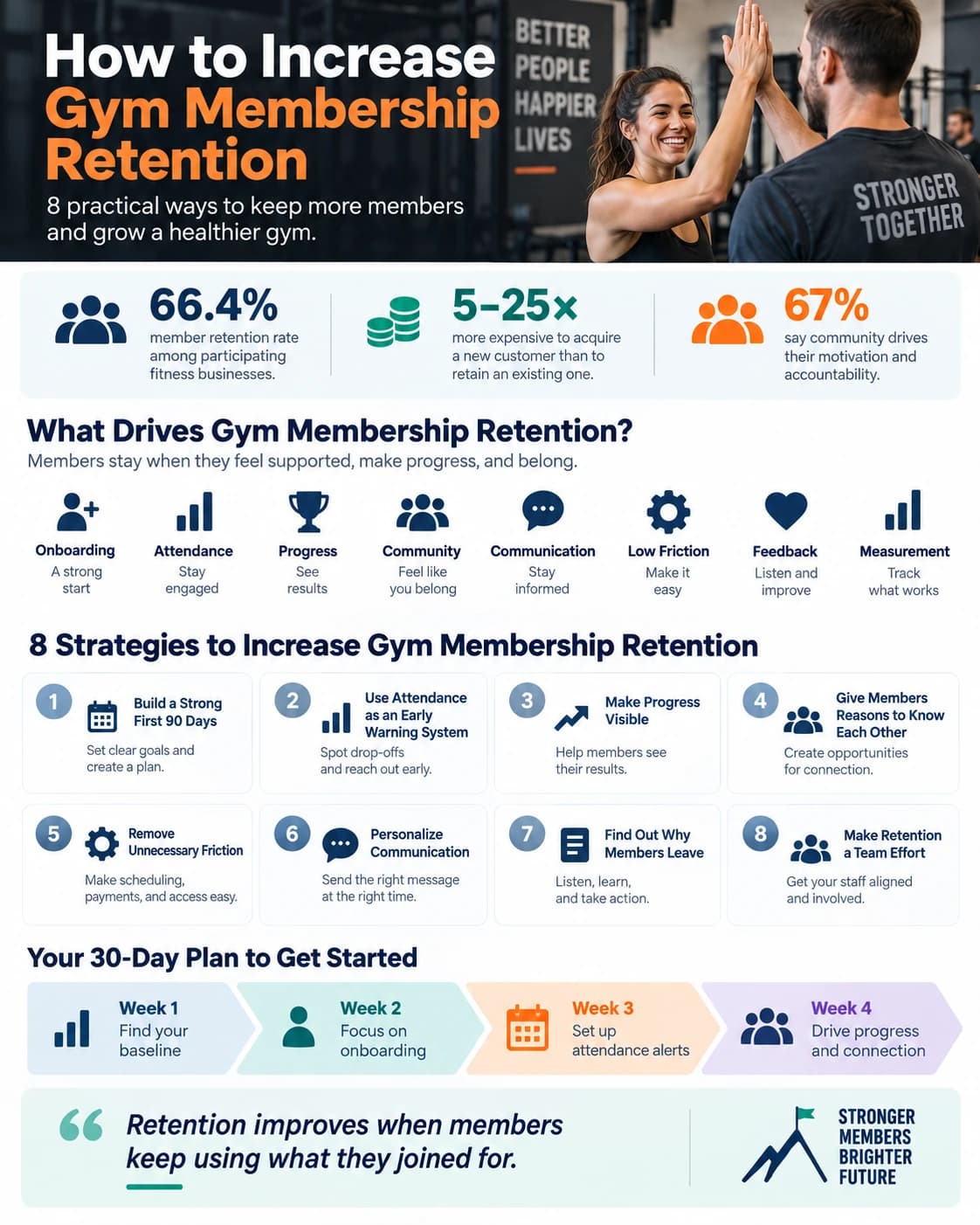
You need a system that does eight things well:
- gets new members into a routine quickly
- notices attendance changes before they become cancellations
- makes progress visible
- creates useful social connections
- removes unnecessary friction
- communicates at the right moments
- learns from cancellations
- gives staff clear responsibility for retention
None of these ideas are particularly flashy.
That is part of the point.
Retention usually improves because ordinary things happen consistently.
Start by measuring the retention problem properly
Before changing your onboarding, launching a challenge, or sending more messages, work out where you actually stand.
A growing member count does not automatically mean retention is healthy.
Imagine you start January with 300 members.
Over the year, you sign up another 180.
By December, you have 340 active members.
At first glance, that sounds like growth.
But how many of the original 300 are still there?
That tells you something very different.
A simple way to measure cohort retention is:
Retention rate = Members from the starting group still active at the end ÷ Members active at the start × 100
If 225 of those original 300 members remain:
225 ÷ 300 × 100 = 75%
Now you have a number you can actually work with.
But do not stop there.
Your annual retention rate tells you whether members are staying. It does not tell you when they leave.
That is where cohort tracking becomes useful.
Look at members who joined in the same period and ask:
- How many are still active after 30 days?
- How many remain after 90 days?
- What happens at six months?
- Do morning members stay longer than evening members?
- Do certain coaches have better retention?
- Do specific membership plans churn faster?
- At what point does attendance usually start falling?
You may discover that your overall retention looks reasonable while your biggest leak happens between weeks six and twelve.
That is a much more useful problem to solve than "we need better retention."
What is a good gym membership retention rate?
The HFA's 2025 report found an average annual retention rate of 66.4% across participating businesses.1
Use that as context, not as a magic target.
A boutique strength gym, a low-cost access gym, a martial arts school, and a Pilates studio do not have identical membership models.
Your strongest benchmark is your own trend.
If you move annual retention from 64% to 70%, something improved.
If it falls from 78% to 69%, something changed.
Also be careful with monthly retention numbers.
96.6% monthly retention sounds excellent.
But if that rate repeats every month for a full year, roughly 66% of the original group remains.
Small leaks compound.
That is why retention deserves regular attention, not one annual review.
1. Build the first 90 days around attendance and early wins
A new member joins on Monday.
They are motivated.
They download the app, buy new shoes, tell a friend they have finally joined a gym, and attend three times in their first week.
Then work gets busy.
They miss Wednesday.
Then Friday.
The next week they only make one session.
Nobody notices.
By week five, going to the gym already feels like something they "used to be doing."
That is the window where retention is often won or lost.
Wodify analyzed more than 14 million attendance data points and found that new clients who had not attended for 20 or more days were 68% more likely to cancel than long-term clients with the same absence.3
That should change how you think about onboarding.
A facility tour is not onboarding.
A welcome email is not onboarding.
Signing the waiver, showing someone the locker room, and saying "see you next week" is administration.
Real onboarding helps a new member turn good intentions into a routine.

A simple 90-day process could look like this:
Day 1 — Learn why they joined. Agree on a realistic weekly attendance target. Show them what they should do next, not everything your gym offers.
First week — Make sure they complete the visits they planned. Introduce them to a coach and a couple of regular members.
Weeks 2–3 — Check whether the schedule is actually working. If attendance already starts slipping, ask why.
Day 30 — Point out something that has improved. Attendance, technique, strength, confidence, mobility, consistency — whatever matters to that member.
Days 45–60 — Give them another target. That might be a challenge, assessment, class milestone, personal best, new skill, or belt requirement.
Day 90 — Show them how far they have come and agree on what they are working toward next.
The exact milestones depend on your business.
At a martial arts school, a beginner may be working toward their first stripe or belt test.
At a strength gym, the early win might be completing 20 sessions or finally feeling confident with basic lifts.
At a yoga studio, simply building a twice-weekly habit may be meaningful progress.
Do not overcomplicate it.
Is this membership becoming part of the person's normal life?
If the answer is no, you want to know early.
2. Use attendance changes as an early warning system
Most gyms record attendance.
Far fewer actually use it.
There is a big difference.
A check-in system can tell you that Sarah attended twelve times last month and four times this month.
The software did its job.
The retention system only starts when somebody does something with that information.
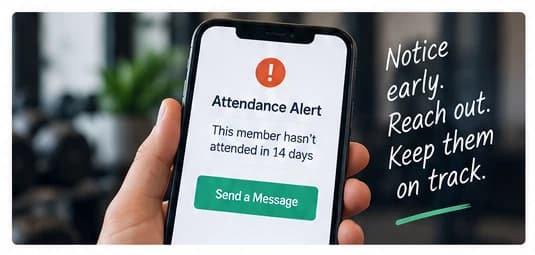
A cancellation request is late information.
By the time a member says, "I need to cancel," they may have been drifting away for a month.
Attendance gives you a chance to act sooner.
But avoid one rigid rule for every member.
"Contact anyone who has not attended in 14 days" is better than doing nothing, but it misses context.
Imagine two members.
Member A — Normally trains five times per week and has only attended once in the last ten days.
Member B — Normally trains once per week and last attended eight days ago.
Member A is showing a much bigger change even though Member B has technically been absent longer.
That is why your system should look for changes from normal behavior, not only days since the last visit.
New member misses a planned early session — Coach sends a quick check-in.
Regular attendance drops sharply — Ask whether something changed with their schedule, motivation, health, or experience.
Several booked sessions are canceled — Help the member find a time that works better.
Normally active member disappears for 7–10 days — Personal message, not a generic campaign.
Absence continues — Call them.
The message itself can be simple:
Hey Sarah, noticed we haven't seen you much this week. Everything okay? If your schedule has changed, I can help you find another class time that works.
That message works because it sounds like a person noticed.
You are not trying to "win back a churn-risk account."
You are trying to find out what happened.
Maybe she is traveling.
Maybe work got busy.
Maybe she injured her shoulder.
Maybe she feels completely lost in class.
The attendance report tells you who to talk to.
The conversation tells you what to do.
This is where software becomes useful.
Monstro-X gym management software can track attendance patterns and member risk information so your staff can see who is falling away instead of relying on memory.
That matters as you grow.
A coach can remember that one of 40 members has disappeared.
Nobody reliably remembers it across 400.
3. Make progress visible before members start questioning the membership
Imagine someone has been training with you for four months.
They are stronger.
They move better.
They know more people.
Their technique has improved.
They attend more consistently than they did in month one.
But nobody has pointed any of that out.
From their perspective, they may simply think:
I'm still not where I want to be.
That is a dangerous gap.
Members experience every workout individually. They do not always step back and notice what three months of improvement looks like.
You need to help them see it.
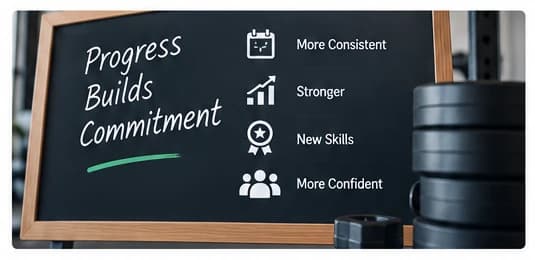
Progress can be made visible through:
- attendance milestones
- personal records
- skills learned
- fitness assessments
- class completion
- consistency streaks
- belt or rank progression
- challenge completion
- coach feedback
- photos or measurements where appropriate
- app achievements
The milestone itself is not the important part.
The meaning behind it is.
"50 classes completed" is fine.
"That's 50 classes since you started. Your squat has improved, you're training twice a week without missing, and you no longer need help setting up the movements" is much stronger.
Now the member can connect the monthly payment with something real.
Be careful with gamification
Points, rewards, badges, streaks, and leaderboards can help.
They can also become noise.
If your leaderboard is permanently owned by your five strongest athletes, the other 95 members may stop caring.
Instead, reward behaviors different types of members can realistically achieve:
- consistency
- improvement
- attendance
- personal milestones
- skills
- participation
- referrals
- helping other members
For martial arts schools, competition within belt levels can make more sense than putting white belts and black belts on the same board.
Monstro-X supports achievements, points, rewards, leaderboards, attendance tracking, and martial arts progression tools.
Those features can make progress easier to see.
But the software does not replace the coach saying:
You've improved a lot since you started.
That conversation still matters.
4. Give members a reason to know each other
"Build a community" appears in almost every gym retention article.
It is good advice.
It is also too vague to be useful unless you explain what community actually looks like.
Community is not a Facebook group nobody uses.
It is not one Christmas party per year.
It starts smaller.
A new member walks in and three people know their name.
A coach introduces two members because they both train at 6 a.m.
Someone notices when a regular misses class.
Two members agree to train together on Saturday.
A parent at your martial arts school knows the other parents sitting next to them.
Those little relationships make the gym harder to replace.
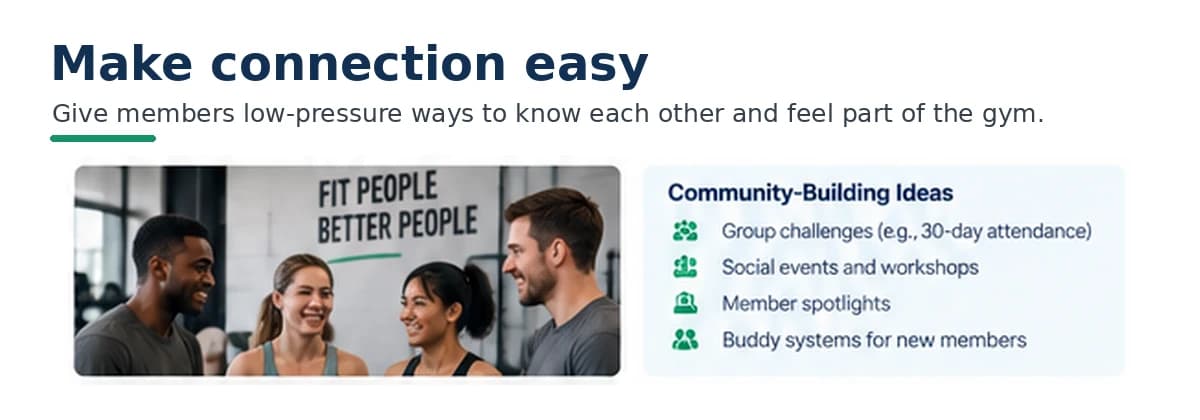
ABC Fitness's 2026 Wellness Watch found that 67% of surveyed members agreed community was their biggest driver of fitness motivation and accountability, while 57% said fitness community significantly affected their long-term commitment to an active lifestyle.4
That does not mean every member wants another social event.
Some people want to train for 45 minutes and leave.
Respect that.
Your job is to make connection available, not compulsory.
Some practical ways to do that:
- introduce new members to regulars
- pair people thoughtfully during sessions
- celebrate birthdays and milestones
- create beginner-friendly events
- run small team challenges
- host occasional workshops or open sessions
- create useful member groups
- recognize members helping other members
- organize low-pressure social activities
For martial arts schools, parent communication matters too.
A child may love the class.
But if the parent does not understand the progress, schedule, next belt test, attendance expectations, or what they are paying for, the membership is still at risk.
The student experiences the program.
The parent often decides whether it continues.
5. Remove the small frustrations that make showing up harder
Not every cancellation is a motivation problem.
Sometimes your gym is simply annoying to use.
A member tries to book a class and cannot work out how.
The class they want is always full.
A schedule changes and nobody tells them.
They have a billing question and wait three days for an answer.
They want to freeze for a month and the process feels like applying for a mortgage.
None of these problems sounds dramatic.
That is exactly why owners overlook them.
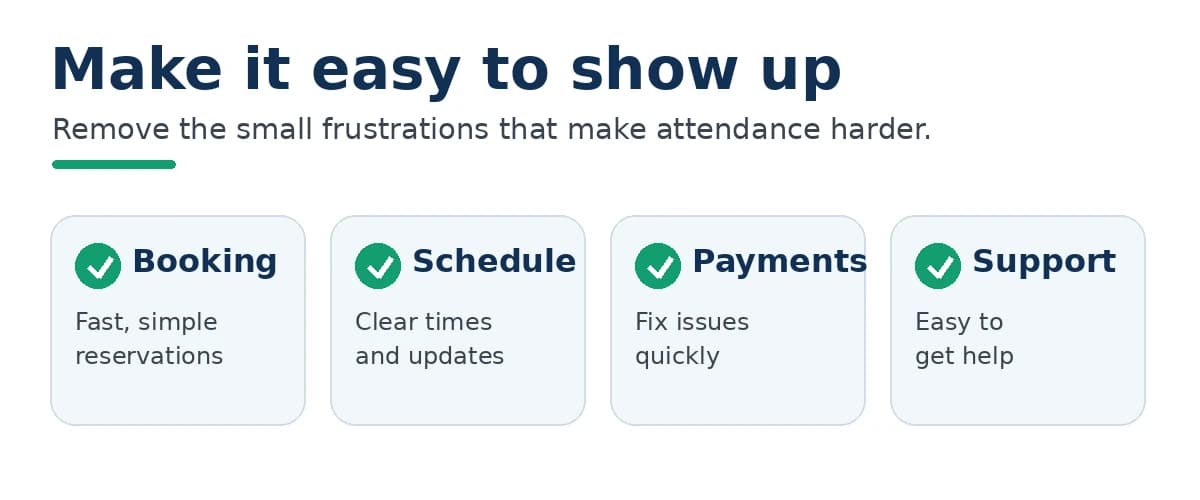
Ask yourself:
How much work does a member have to do to keep using your gym?
Booking — Can they reserve a class without confusion?
Schedule — Can they quickly see what is happening today?
Capacity — Are popular sessions constantly unavailable?
Communication — Do members know when something changes?
Billing — Are failed payments handled quickly and privately?
Support — Does the member know who to contact?
Membership changes — Can somebody freeze or downgrade when life temporarily changes?
Sometimes the best retention decision is not convincing someone to keep the exact membership they have.
A member who cannot train for six weeks because of work may be better moved to a freeze.
Someone whose schedule changed may need another plan.
A parent struggling with timing may simply need another class option.
There is also a line you should not cross.
Do not confuse retention with making cancellation difficult.
Making people send certified letters, visit in person during strange office hours, or argue with staff may delay a cancellation.
It does not create loyalty.
It creates bad reviews and people who will never come back.
Good retention removes reasons to leave.
It does not trap people who already need to.
6. Personalize communication without turning your gym into a notification machine
Automation is useful when it helps your staff remember important moments.
It becomes a problem when every member interaction starts sounding like software.
You have probably experienced this yourself.
You miss one class and receive:
WE MISS YOU! Come crush your goals!
Then another message twelve hours later.
Then a discount.
Then a "last chance."
Nothing about that feels personal.
A better system uses automation to make sure the right moment is not missed, then decides whether the response should be automated or human.
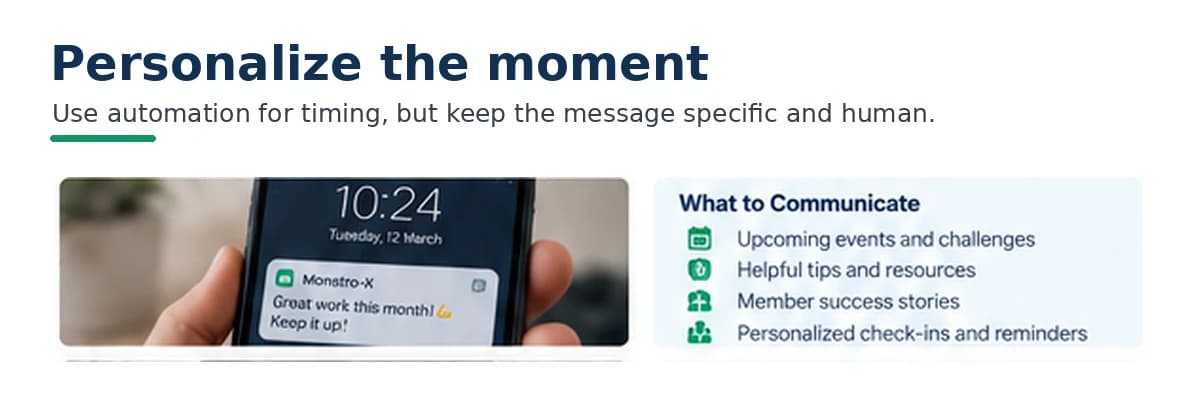
Useful triggers might include:
New signup — Welcome them and tell them exactly what happens next.
First class completed — Congratulate them and recommend the next session.
Attendance milestone — Recognize it.
Unexpected attendance drop — Personal message from a coach.
Birthday or membership anniversary — Acknowledge it.
Upcoming assessment or belt test — Tell them what they need to prepare.
Failed payment — Send clear instructions for fixing it.
Extended absence — Human follow-up.
The rule is simple:
Do not send five automated messages where one useful message will do.
And make it obvious who is speaking.
"Hey Mike, Chris from Westside Strength here" feels human.
"Dear valued member" does not.
Monstro-X includes reminders, push notifications, workflows, attendance information, and community tools that can support this system.
The purpose of the software is consistency.
It should help your staff remember the relationship, not pretend to be the relationship.
7. Find out why people leave instead of inventing the reason yourself
A member cancels.
The owner says:
Probably price.
Another member leaves:
They got busy.
Another disappears:
They lost motivation.
Maybe.
But once you start explaining every cancellation yourself, you stop learning anything.
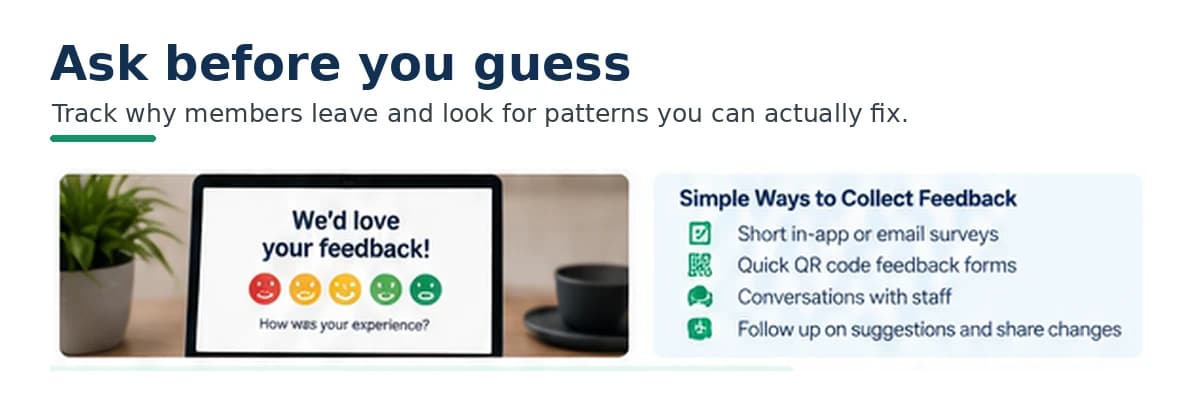
Track cancellation reasons consistently.
Keep the list simple:
- moved away
- financial pressure
- schedule conflict
- injury or health
- low attendance
- class availability
- dissatisfaction with coaching
- lack of visible progress
- switched to another activity or competitor
- temporary life change
- unknown
Do not turn the exit process into an interrogation.
One question is enough:
Thanks for training with us. Before I close the membership, would you mind telling me the main reason you're leaving? We use the feedback to improve the gym.
Then look for patterns.
One person asking for a Sunday class tells you very little.
Fifteen people leaving because your evening classes are full tells you something.
One parent complaining about communication may be a one-off.
Ten parents saying they never know what their child is working toward is a system problem.
The same principle applies before cancellation.
Ask active members:
- How is training going?
- Are your current class times still working?
- Do you feel like you are making progress?
- Is anything making it harder to attend?
- What would improve your experience?
The best time to discover a retention problem is while the member still belongs to you.
8. Make retention part of the staff's job
Retention falls apart quickly when everyone assumes somebody else is handling it.
The owner thinks the coaches will notice attendance.
The coaches think the front desk is contacting absent members.
The front desk thinks the manager has a report.
The manager thinks the software sends something automatically.
Nobody actually owns the outcome.
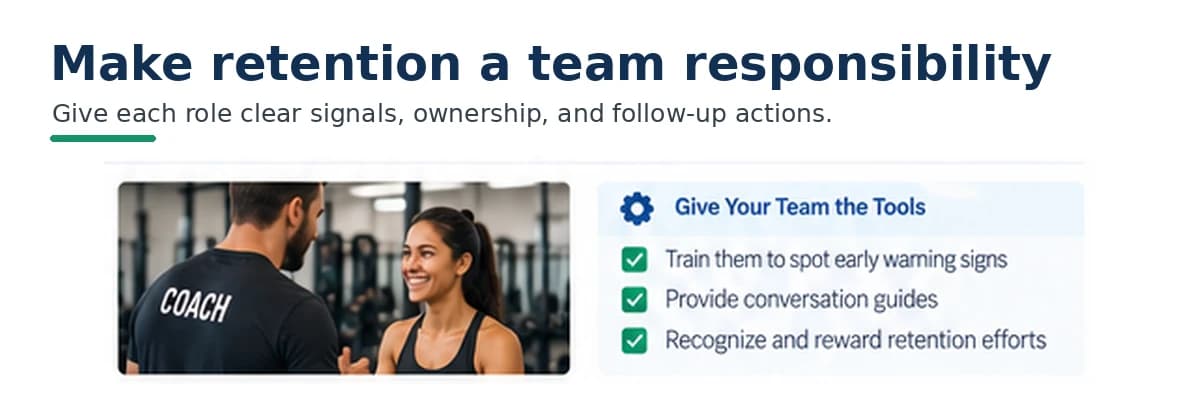
Give people clear responsibilities.
Front desk — Check-ins, booking questions, billing issues, account changes.
Coaches — Know names, notice changes, discuss goals, recognize progress, introduce members to each other.
Member success or manager — Review absence reports, handle at-risk outreach, run new-member check-ins, track cancellation reasons.
Owner — Review retention trends, fix recurring problems, coach the team, and decide which initiatives deserve more investment.
You do not necessarily need a dedicated "retention manager."
You need ownership.
This becomes much more important as you grow.
When you have 50 members, you can run much of the business from memory.
At 500 members, memory is not a system.
A simple gym retention dashboard
You can build a dashboard with 40 numbers.
Then nobody looks at it.
Start smaller.
You want enough information to show whether members are attending, progressing, paying, and staying.
Monthly member retention — How much of your existing base remains.
30/90/180-day cohort retention — Shows where new members tend to drop out.
Average visits per member — Gives you a view of participation.
Members with declining attendance — Your early-warning list.
Members with no visit in X days — Shows who has gone inactive.
Membership freezes — Potential future churn worth understanding.
Failed payments — Preventable membership losses.
Cancellation reasons — Shows why people are actually leaving.
Average membership length — Helps show whether retention is improving over time.
Do not panic over one strange month.
December may look different from February.
School holidays affect family programs.
Weather affects attendance.
Local events matter.
Look for trends.
More importantly, look for trends you can act on.
A 30-day plan to improve gym membership retention
Do not try to implement everything in this article on Monday morning.
That usually ends with a giant spreadsheet nobody opens again.
Build the system in order.
Week 1: Find the leak
Calculate your current retention.
Then separate members by join date.
Look at:
- 30-day retention
- 90-day retention
- six-month retention
- annual retention
Find the period where the biggest drop happens.
Then pull a list of currently active members whose attendance has declined.
Now you have two things:
A historical problem.
And people you may still be able to help.
Week 2: Fix the first 90 days
Write down what should happen for every new member.
Not what sometimes happens when your best coach is working.
What should happen every time.
At minimum:
Goal — Why did the person join?
Schedule — How often are they realistically going to attend?
Owner — Which staff member is responsible for noticing if they disappear?
Check-ins — When will someone follow up?
Milestone — What early progress should they be able to see?
Keep it simple enough that your team will actually use it.
Week 3: Build the attendance warning system
Decide what behavior deserves attention.
New member misses two planned sessions — Coach outreach.
Regular member attendance drops by half — Check-in.
Normally active member absent 10 days — Personal message.
Repeated no-shows — Schedule conversation.
Give one person responsibility for reviewing the list.
Do not automate everything yet.
Run the process manually first.
Once you know what works, automate the repetitive parts.
Week 4: Add one progress system and one connection system
Pick one of each.
Progress could be:
- every 25th visit
- monthly coach check-in
- fitness assessment
- belt tracking
- personal record
- app achievement
Connection could be:
- new-member introductions
- small group challenge
- monthly social session
- member group
- training partner system
- milestone recognition
Then leave the system alone long enough to measure it.
Retention improvements do not always show up in seven days.
Look at attendance and cohort retention over the next few months.
Retention starts long before someone asks to cancel
A member does not usually wake up one morning completely engaged and cancel that afternoon.
There is normally a drift.
They attend less.
Nobody notices.
Progress becomes harder to see.
The gym stops feeling like part of their routine.
Messages become easier to ignore.
Eventually the monthly payment starts looking like something they are no longer using.
That is why the best retention work happens earlier.
Notice the attendance change.
Talk to the member.
Make progress visible.
Give coaches responsibility.
Remove friction.
Help people build relationships.
Then use software to make sure those things happen consistently as the business grows.
Monstro-X can support that system with attendance tracking, member risk information, achievements and rewards, progression tools, community features, communication, automation, referrals, and reporting.
But start with the operating system.
Software makes a good retention process easier to run.
It does not rescue a process that does not exist.
Sources & References
Footnotes
-
Health & Fitness Association — 2025 Fitness Industry Benchmarking Report. Based on data from 175 companies representing more than 17,000 fitness facilities across 27 countries. Reported average annual member retention: 66.4%. ↩ ↩2
-
Harvard Business Review — The Value of Keeping the Right Customers. Discusses estimates that acquiring a new customer can cost five to 25 times more than retaining an existing one, depending on the study and industry. ↩
-
Wodify — Behind the Numbers: Why New Members Leave and How to Make Them Stay. Analysis of more than 14 million attendance data points; new clients with at least 20 days of absence were 68% more likely to cancel than long-term clients with the same absence. ↩
-
ABC Fitness — 2026 Mid-Year Wellness Watch. Reported that 67% of surveyed members agreed community was their biggest driver of fitness motivation and accountability, while 57% said fitness community significantly affected long-term commitment to an active lifestyle. ↩