Why Your Text Campaign Doesn't Work for Your Gym: People Hate How You Do It
August 14, 2026
There is a common belief among gym owners that people simply don't like talking to businesses.
They see a text campaign produce a handful of replies, a few "no thanks" messages, several STOP requests, and a long list of people who never respond. The conclusion seems obvious:
"People don't want businesses texting them."
But that conclusion is probably wrong.
People don't necessarily hate receiving texts from businesses. They hate receiving bad texts from businesses.
SMS is an unusually personal communication channel because it arrives in the same place people communicate with friends, family, and colleagues. That creates both an opportunity and a problem. Consumers can be receptive to business texting when the message is relevant and valuable, but the same channel can feel intrusive when a company treats it like a billboard.
Research supports that distinction.
In Klaviyo's 2024 global SMS research, consumers identified SMS as a meaningful communication channel, and the factors that increased willingness to subscribe included discounts, the ability to ask questions and receive fast responses, unique experiences, personalization, and knowing there is a person on the other end of the message.
That last point is particularly important for gyms.
A gym is not selling a parcel of socks.
It is selling a relationship with coaches, a place to train, a community, a routine, and, ultimately, a result.
So when a gym sends a database campaign, the objective shouldn't be to "send an offer to 5,000 people."
The objective should be to start a conversation with the right people.
Based on Monstro X's experience running database campaigns, the campaigns that actually drive people back into the gym behave very differently from typical mass-text blasts. In fact, in a recent campaign we ran for a Jiu-Jitsu school in Arlington, we reached out to roughly 600 people from their existing database and generated 40 trial-class show-ups.
Not clicks. Not replies. Not “interested” messages.
Forty people physically showed up to train.
That outcome highlights the real difference between a successful SMS campaign and a noisy one.
It isn’t the size of the send.
It’s how the conversation begins and whether it leads to someone walking through the door.
Here are the mistakes we see gym owners make repeatedly.
1. Your message is too long
The first mistake is deceptively simple: the gym tries to explain everything in the first text.
The message contains the offer, the history of the gym, the benefits, the terms, the schedule, a link, the deadline, the price, the membership options, and a call to action.
It might look like this:
Hi John! We hope you're doing well. We're reaching out because we're currently running an exclusive promotion for former members. If you've been thinking about getting back into training, we'd love to welcome you back. We're offering 30% off our membership for new and returning members until Friday. This includes unlimited access to our facility, group fitness classes, personal training consultations, our mobile app, nutrition guidance and...
By the time the recipient reaches the important part, they've already mentally checked out.
SMS is not email.
Klaviyo's SMS guidance explicitly recommends keeping messages short and concise, noting that longer messages reduce engagement and clarity. Its consumer research also shows that people prefer simple, immediately understandable messages over information-heavy ones.
The job of the first text isn't to explain everything.
The job of the first text is to earn the next response.
Instead of:
"Here's everything you need to know..."
think:
"Hey Mike, it's James from ABC Gym. We haven't seen you in a while. Want to come back and train with us?"
Now there is a conversation.
If Mike replies "Sure", you've earned the right to explain the offer.
Most campaigns fail because they try to close the sale before the conversation even exists.
2. Your message sounds like a business begging for a sale
This is probably the biggest psychological mistake.
People know when they're being marketed to.
And the more a message sounds like a marketing blast, the less it feels like a real conversation.
Compare:
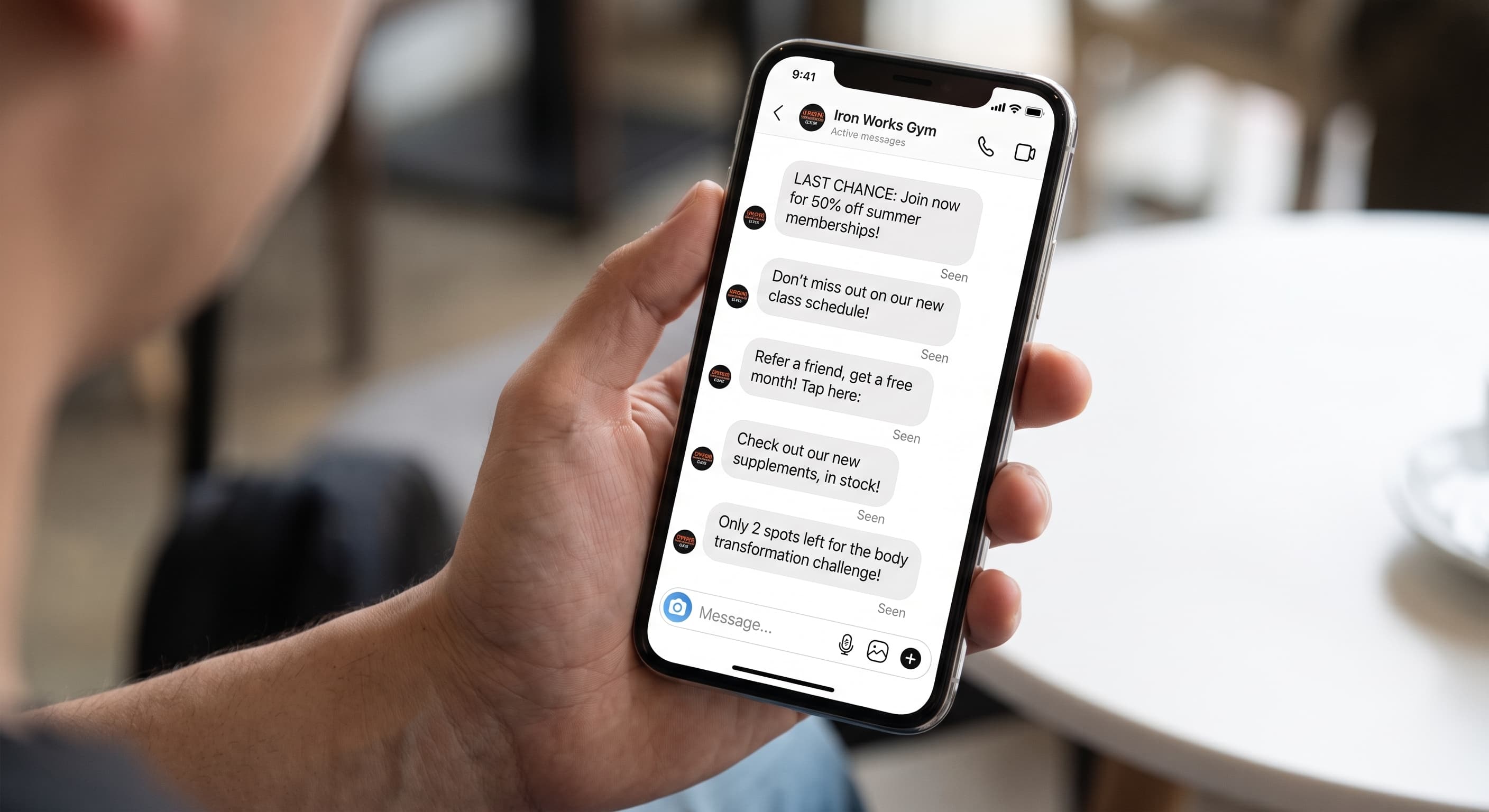
"🔥 LIMITED TIME OFFER! RETURN NOW AND GET 50% OFF YOUR MEMBERSHIP! CLICK HERE TO CLAIM!"
with:
"Hey Sarah, it's Mike from XYZ Gym. We were talking about you the other day. How have you been?"
The second message doesn't even contain an offer.
That's intentional.
The first message says:
"We want your money."
The second says:
"We’re reaching out to you."
That difference matters because trust and perceived personalization strongly influence SMS engagement. Klaviyo’s research found that consumers are significantly more receptive when they believe a real person is behind the message and when the communication feels relevant to them.
A gym already has an advantage here.
You’re not a stranger.
You’re often someone they’ve trained with, spoken to, or at least visited before.
That relationship is your leverage.
Don’t waste it by sounding like a billboard.
3. Personalization isn't just putting their first name in the message
Adding "Hey John" to a mass message doesn't make it personal.
Real personalization comes from understanding who you're talking to.
A former member who trained for three years is not the same as someone who attended twice.
Someone who left due to injury is not the same as someone who left due to price.
Someone who used to train every Monday, Wednesday and Friday is not the same as someone who came occasionally.
The database already contains this information.
Use it.
Klaviyo’s research emphasizes that behavioral relevance and segmentation significantly improve engagement because messages feel more intentional and less generic.
For example:
"Hey Sarah, you used to train with us on Tuesday nights. We've added a new 6 class—thought you might like it."
That feels personal.
Not because of the name.
Because of the memory.
4. The first "yes" should not immediately become a link
This is one of the biggest mistakes in database campaigns.
Imagine the gym sends:
"Hey John, we've got something special for former members. Want to hear about it?"
John replies:
"Sure."
And the gym immediately responds:
"Great! Click here to register: [link]"
The conversation just died.
The person didn’t say yes to a checkout page.
They said yes to a conversation.
So continue it.
Ask something:
"Awesome. What are you looking to get back into strength, classes, or just getting into a routine?"
Now you understand intent.
And intent is what allows you to make the offer relevant.
SMS works best when it behaves like a conversation, not a funnel. Klaviyo’s research shows that consumers value the ability to ask questions and receive fast responses via text, which is exactly what this moment should become.
5. Your offer isn't compelling enough
Of course, good conversation can't rescue a weak offer.
A common gym campaign says:
"Come back and get 10% off your first month."
But why should someone care?
If they already decided not to return, 10% rarely changes that decision.
A compelling offer isn’t just about discounting.
It’s about timing and relevance.
Maybe there’s a new program.
Maybe there’s a new coach.
Maybe former members can restart without an enrollment fee.
Maybe they get a free session or trial week.
Maybe the gym has meaningfully changed since they left.
The real question is:
"Why should this person come back now?"
not
"How much can we discount it?"
Klaviyo’s consumer data shows that while discounts are effective, they are only one of several motivators; personalization, experience, and conversational access also play a major role in engagement.
6. You're asking the prospect to take too much risk
From the gym’s perspective:
"It’s just a membership."
From the prospect’s perspective:
"Am I signing a contract? Will I have time? What if I don’t like it? What if nothing has changed?"
The perceived risk is often higher than the gym assumes.
That’s why the first step should be small.
Not a membership.
A conversation.
A visit.
A trial.
A class.
A low-friction re-entry point.
The goal is to reduce the distance between:
"I’m interested."
and
"I’m back in the gym."
Once they’re physically there, everything changes.
The environment does the selling.
7. You're sending thousands of messages before knowing what works
This is one of the most expensive mistakes.
A gym has 10,000 contacts.
Someone writes a message.
Builds an offer.
And sends it to everyone.
Only then do they find out whether it works.
That’s backwards.
A database is not just volume, it’s a testing environment.
A smarter approach:
Send to a small segment first.
Measure:
- Replies
- Conversations
- Bookings
- Show-ups
- Unsubscribes
Then adjust.
Then scale.
Because if 100 people receive a message and almost nobody responds, sending it to 10,000 people won’t fix the problem—it will just amplify it.
Modern SMS platforms increasingly emphasize this idea of segmentation and behavior-based messaging because broad blasts consistently underperform compared to targeted communication.
8. You don't give people a reason to act now
"Let us know if you're interested."
That’s easy to ignore.
There’s no urgency, no consequence, no reason to act today.
People delay decisions constantly.
So they delay this one too.
This is where real urgency matters.
If the offer ends Friday, say so.
If there are limited spots, say so.
If the program starts Monday, say so.
But don’t fake it.
People can tell.
The purpose of urgency is not pressure.
It’s decision clarity.
Klaviyo’s research shows SMS can significantly accelerate purchase timing when combined with relevance and convenience—meaning people often act sooner when the message gives them a clear reason to do so.
The campaign should feel like a conversation, not a broadcast
Put it all together and the pattern becomes clear.
Most gym campaigns look like:
Database → mass message → long pitch → link → discount → hope
But the campaigns that actually work look more like:
Relevant people → short message → conversation → intent → tailored offer → low-friction step → show-up
That difference is everything.
And it explains why, in our Arlington Jiu-Jitsu campaign, reaching out to roughly 600 people led to 40 trial-class show-ups.
Not because of a clever ad.
Not because of a big discount.
But because the campaign created enough real conversations that people actually came back into the gym.
The real KPI isn't the reply rate
Reply rate is useful.
Clicks are useful.
Bookings are useful.
But for a gym, the only metric that truly matters is:
Did they show up?
Because everything else is just a step toward that moment.
A person walking through your doors is where marketing becomes real.
That’s where coaching, community, and experience take over.
And that’s what turns a message into revenue.
The best gym text doesn't sound like marketing
Before sending a campaign, read it out loud.
Does it sound like a human?
Or a marketing department?
Compare:
"🔥 LIMITED TIME OFFER! CLAIM YOUR DISCOUNT NOW!"
vs
"Hey Mike, it’s Josh from the gym. We’ve got a new strength program starting next week and I thought you’d be into it. Want me to send you the details?"
One feels like advertising.
The other feels like a conversation.
And when Mike replies:
"Yeah, what’s it like?"
you’ve already won the most important part.
He’s talking to you.
The problem isn't that people don't like talking to businesses
People don’t hate businesses texting them.
They hate being treated like a database entry.
They don’t want generic blasts, aggressive sales pushes, or immediate checkout links.
But they do respond to messages that are:
- Short
- Relevant
- Personal
- Conversational
- Low-risk
- Timely
And most importantly, human.
That’s why campaigns like the one we ran for the Arlington Jiu-Jitsu school work at all.
Not because SMS is magic.
But because when you stop broadcasting and start conversing, people actually respond.
And sometimes, as that campaign showed, a few hundred well-handled conversations are enough to bring dozens of people back through the door.
That’s the real opportunity most gyms are missing.
Not more messages.
Better conversations.