
15 Lead Generation Ideas for Gyms That Actually Turn Into Members
September 19, 2026
You generate 40 leads this month.
Sounds good.
Then you look closer.
Twelve never answer you. Eight say they were "just checking prices." Five book a trial and do not show up. Two eventually become members.
Next month, someone suggests solving the problem by generating 60 leads instead.
That may help. Or it may simply give you 20 more people to lose.
That is the problem with most lists of lead generation ideas for gyms. They focus almost entirely on getting names, phone numbers, and email addresses into a database.
But a lead is not a new member.
For a gym, the useful system looks more like this:
Discovery → Inquiry → Response → Booked Trial → Show-Up → Enrollment
Every lead generation idea in this article should eventually feed that process.
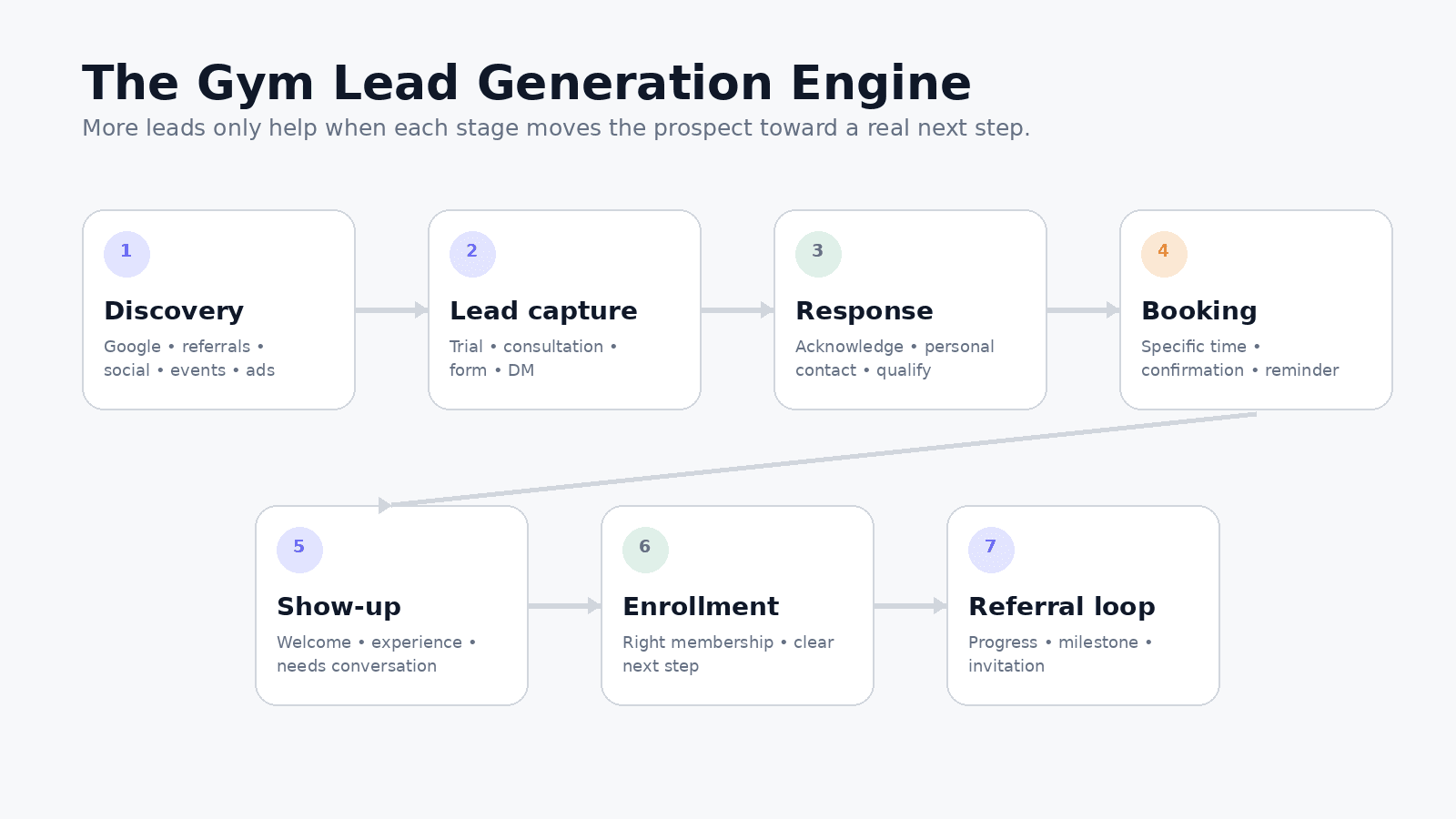
If you already generate plenty of inquiries but very few enrollments, fix the middle of that process before spending more money at the top.
We have covered this problem before: getting more website leads will not solve a weak enrollment process.
If you genuinely need more people entering the pipeline, the ideas below give you several places to start.
But you probably should not use all of them.
The goal is to build a few dependable lead sources that you can actually operate well.
1. Turn Your Google Business Profile Into a Lead Source
For a local gym, your Google Business Profile is not administrative housekeeping.
It is part of your sales process.
Someone searches for a gym nearby and sees your rating, reviews, photos, hours, location, website, and several competing gyms beside you.
Before they fill out a form, they are already comparing you.
There is a big difference between interrupting someone scrolling Instagram and appearing in front of someone searching for "beginner gym near me."
One person needs to be convinced they should care.
The other already has a problem they are trying to solve.
Google says local results are mainly influenced by relevance, distance, and prominence. Complete business information, reviews, and photos can help customers find and evaluate a local business.
You can read more in Google's guidance on improving local ranking.
At minimum:
- Choose the correct primary business category.
- Keep your opening hours accurate.
- Add current photos of real classes.
- Show the entrance so first-time visitors recognize it.
- Add your website and a clear booking link.
- Respond to customer reviews.
- Keep your phone number accurate.
- Make the next action obvious.
Do not upload fifteen photos of empty equipment.
Show what joining actually looks like.
A nervous beginner cares more about whether your gym feels welcoming than whether you own six squat racks instead of four.
Build a Review Process Rather Than Randomly Asking
You should also ask members for reviews consistently.
But do not offer discounts, free merchandise, or other incentives in exchange for Google reviews. Google explicitly prohibits incentivized reviews in its review policies and guidance.
Instead, build the request around natural moments.
A member completes their first challenge. Someone tells a coach they love the gym. A parent says their child has become noticeably more confident. A member hits a milestone they have worked toward for months.
That is a natural time to say:
"Glad you're enjoying it. Would you mind leaving us a Google review? It really helps people nearby understand what the gym is actually like."
Give your staff a simple process for recognizing those moments, asking for reviews, and making it easy for members to find your review page.
You do not need to chase every member after every class.
You need a repeatable process that keeps your online reputation connected to the experience people actually have inside your gym.
2. Build Pages for the Programs People Actually Search For
Your homepage cannot rank for everything and explain everything equally well.
Suppose your gym offers:
- Personal training
- Strength classes
- Beginner fitness
- Weight-loss programs
- Boxing
- Youth conditioning
Those people may be looking for completely different things.
Create useful pages around the services and audiences you genuinely serve.
For example, a page about strength training in Austin should explain your coaching style, schedule, who the program suits, where the gym is, what beginners should expect, and how to book an intro.
A page about kids boxing in Austin should talk directly to parents. Explain age groups, safety, coaching, scheduling, what happens during the first class, and how progression works.
The page should answer the questions somebody would normally have to call you about.
Give Every Program Page a Clear Next Step
A program page should not end with a generic contact form that leaves the visitor wondering what happens next.
Someone reading about your beginner strength program should be able to book a beginner introduction.
Someone researching your children's martial arts classes should be able to arrange an age-appropriate trial.
Make the next step relevant to the program.
Also include real photos, your location, your schedule, and answers to the questions you hear most often.
Do not create fifty nearly identical pages with different neighborhood names pasted into the heading.
A local page only deserves to exist when it genuinely helps someone from that area decide whether your gym fits them.
3. Send Campaign Traffic to a Landing Page, Not Your Homepage
A homepage has a difficult job.
It might need to explain your facility, classes, coaches, pricing philosophy, community, schedule, location, merchandise, and half a dozen other things.
An advertising landing page has one job.
A parent clicked an ad for a kids martial arts trial?
Take them to the kids martial arts trial.
Someone clicked an ad for your six-week beginner strength program?
Take them directly there.
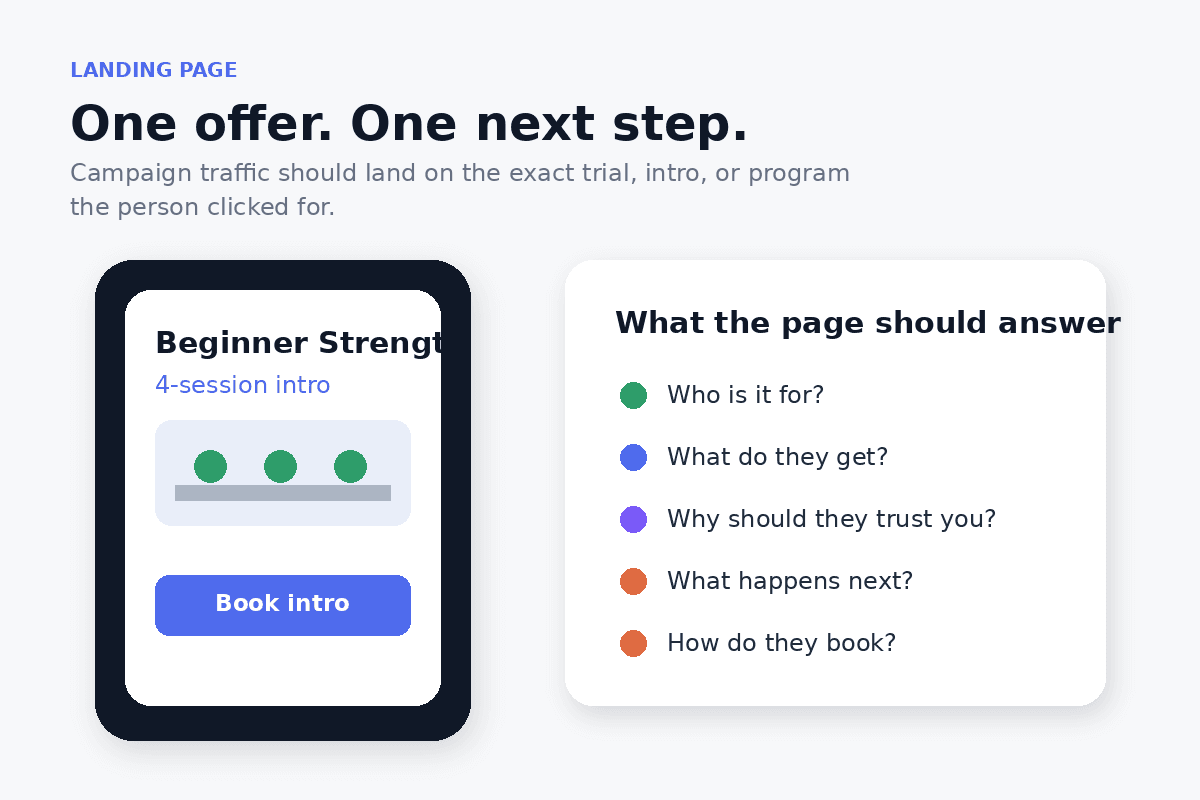
Gymdesk makes the same distinction in its landing-page guidance for gyms: a dedicated landing page is built around one focused action rather than asking visitors to navigate an entire website first.
Keep the page simple:
- Who is this for? Explain the intended audience.
- What do they get? Describe the offer and what it includes.
- Why should they trust you? Show your coaches, facility, and genuine member experiences.
- What happens next? Explain the booking and first-visit process.
- How do they book? Give them one obvious action.
Do not make someone find the offer they literally just clicked.
Keep Your Lead Capture Form Simple
You do not need someone's entire life history before they have even visited your gym.
For most introductory offers, their name, contact information, and preferred session may be enough to start the conversation.
You can learn more about their goals once your team speaks with them.
Make sure the form works properly on mobile devices and that the submission reaches someone who can respond.
Then test it yourself.
Submit an inquiry as if you were a new member.
How long does it take to receive a response?
Does the confirmation explain what happens next?
Can you book without sending three more messages?
A landing page can look beautiful and still lose leads because the booking process is unnecessarily difficult.
4. Build Referrals Around Member Milestones
Your existing member base is one of the few audiences where trust already exists.
But there is a mistake here too.
Owners often think, "Our members love us. They'll tell their friends."
Some will.
Most will go to class, train, drive home, and continue with their lives.
If you want referrals to become a dependable lead source, give them a reason and a moment to happen.
A generic poster saying REFER A FRIEND — GET $25 is easy to ignore.
A referral request immediately after someone accomplishes something meaningful feels completely different.
Imagine a member just:
- Completes their 50th class.
- Earns a new belt.
- Hits a personal record.
- Finishes a six-week challenge.
- Reaches a fitness milestone.
- Wins an internal competition.
- Reaches a one-year membership anniversary.
They are already talking about the gym.
That is the moment to make sharing easy.
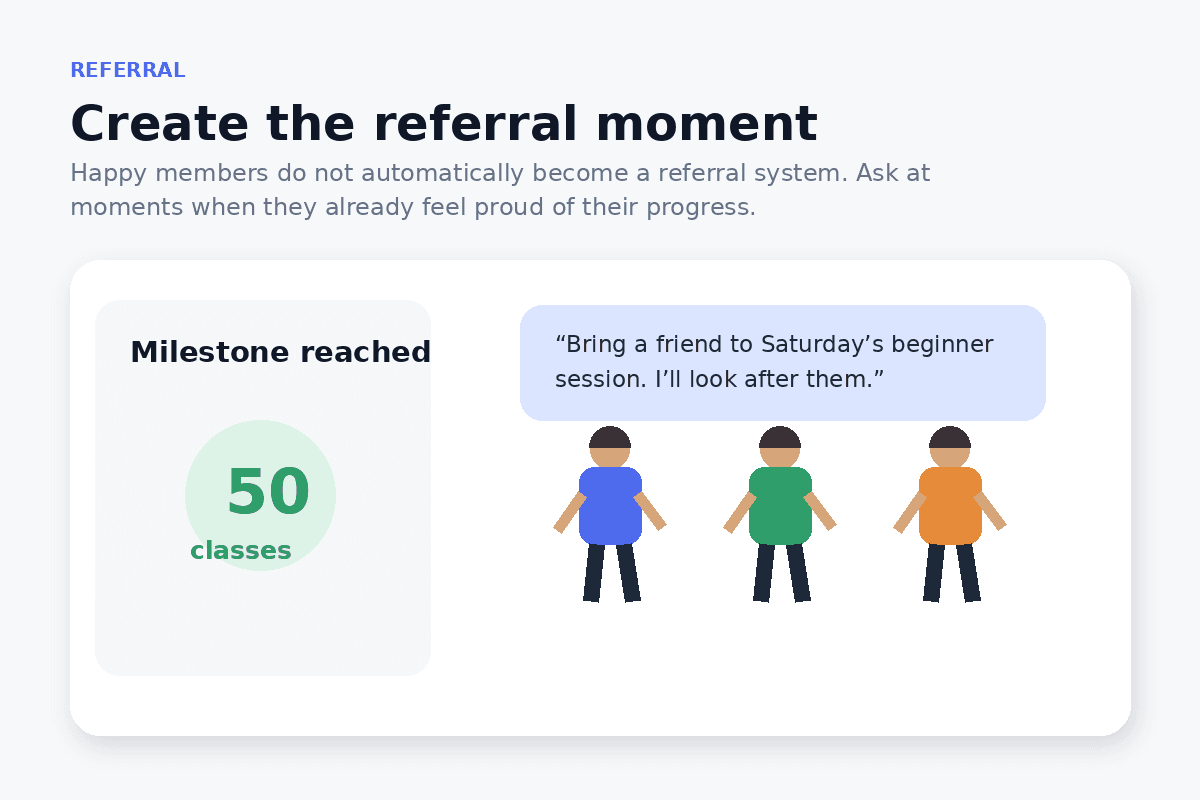
You might say:
"You've made serious progress since you started. If you've got a friend who's been talking about getting into training, bring them to Saturday's beginner session. I'll look after them."
That feels like an invitation.
Not a sales assignment.
This is also the thinking behind creating referral moments instead of simply hoping happy members refer people.
Make Referrals Easy to Track
A member mentions a friend to a coach.
The friend attends a trial two weeks later.
Nobody remembers who originally referred them.
Now the owner cannot tell whether the referral program is actually working.
Give each referral a clear way to enter your system.
That could be a member referral code, a referral link, or simply a required field on your trial registration form.
Decide what happens when the referred person enrolls and who is responsible for acknowledging the referring member.
Software can help once the process exists. For example, Monstro-X gym management software can support referral tracking, rewards, achievements, member communication, and reporting so staff do not have to remember every referral manually.
5. Run a Bring-a-Friend Week
"Bring a friend" works because it removes one of the biggest barriers for a prospective member:
Walking into an unfamiliar gym alone.
Instead of asking members to sell memberships, create an easy event they can invite someone to.
A strength gym could run Beginner Partner Saturday.
A martial arts school could hold Parents & Kids Intro Week.
A boxing gym could run Bring a Training Partner Night.
The class should be designed for guests.
Do not invite complete beginners into the hardest normal session you run and assume they will understand what is happening.
Give staff the guest list beforehand. Welcome people by name. Collect contact details properly. Then give each guest an obvious next step before they leave.
Follow Up With Every Guest After the Event
The event is not the entire lead generation system.
The follow-up afterward matters just as much.
Before guests leave, find out whether they enjoyed the session and what they were hoping to achieve.
If someone is interested in continuing, offer a specific next appointment.
For example:
"Glad you enjoyed the session. We have beginner introductions on Tuesday and Thursday. Would you like me to book you into one?"
Record whether the guest books, attends, and eventually enrolls.
That gives you a much clearer picture of whether your bring-a-friend events are producing real membership opportunities.
6. Turn Member Stories Into Lead-Generating Content
The average gym's social feed is full of exercises.
Burpees. Deadlifts. Pad work. Someone pushing a sled.
None of that is necessarily bad.
But prospective members usually have a different question:
Can someone like me actually do this?
Member stories answer that much better.
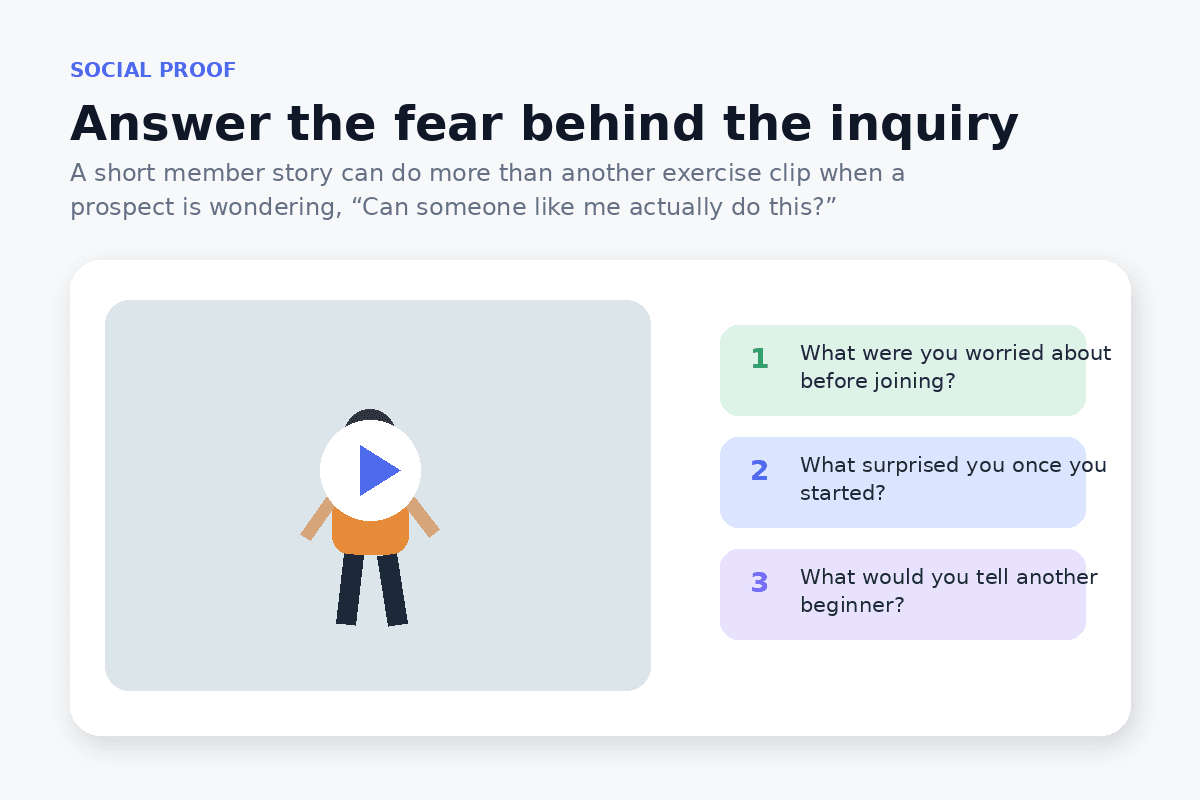
Show the 44-year-old beginner who had never touched a barbell.
Show the parent whose child was nervous during their first martial arts class.
Show someone who started with two sessions per week and gradually became consistent.
You do not need to turn every member into an inspirational documentary.
A thirty-second video can work.
Ask:
"What were you worried about before joining?"
"What surprised you when you actually started?"
"What would you tell somebody considering their first class?"
That is useful marketing because it deals with the fear behind the inquiry.
Connect the Story to a Relevant Offer
A great member story might generate attention without producing a single inquiry.
Give viewers a natural next step.
For example, a story about a beginner who started strength training could end with an invitation to your next beginner introduction.
A parent talking about their child's first martial arts class could lead to an age-specific trial booking page.
Always get permission before publishing a member's photo, video, or personal story. For children, obtain appropriate parent or guardian consent.
The story should help prospective members picture themselves inside your gym.
The offer should make it easy for them to take the next step.
7. Build Partnerships With Nearby Businesses
Your market is probably smaller than you think.
You do not need everybody in your city.
You need enough of the right people within a realistic distance of your facility.
That makes local relationships surprisingly useful.
Look for businesses serving people who overlap with your ideal members but do not directly compete with you.
For example:
- Physical therapy clinics
- Chiropractors
- Massage therapists
- Sporting goods stores
- Healthy cafes
- Running stores
- Youth sports clubs
- Schools
- Apartment buildings
- Local employers
Do not approach them with, "Can you promote my gym?"
That relationship will not last long.
Give them something useful too.
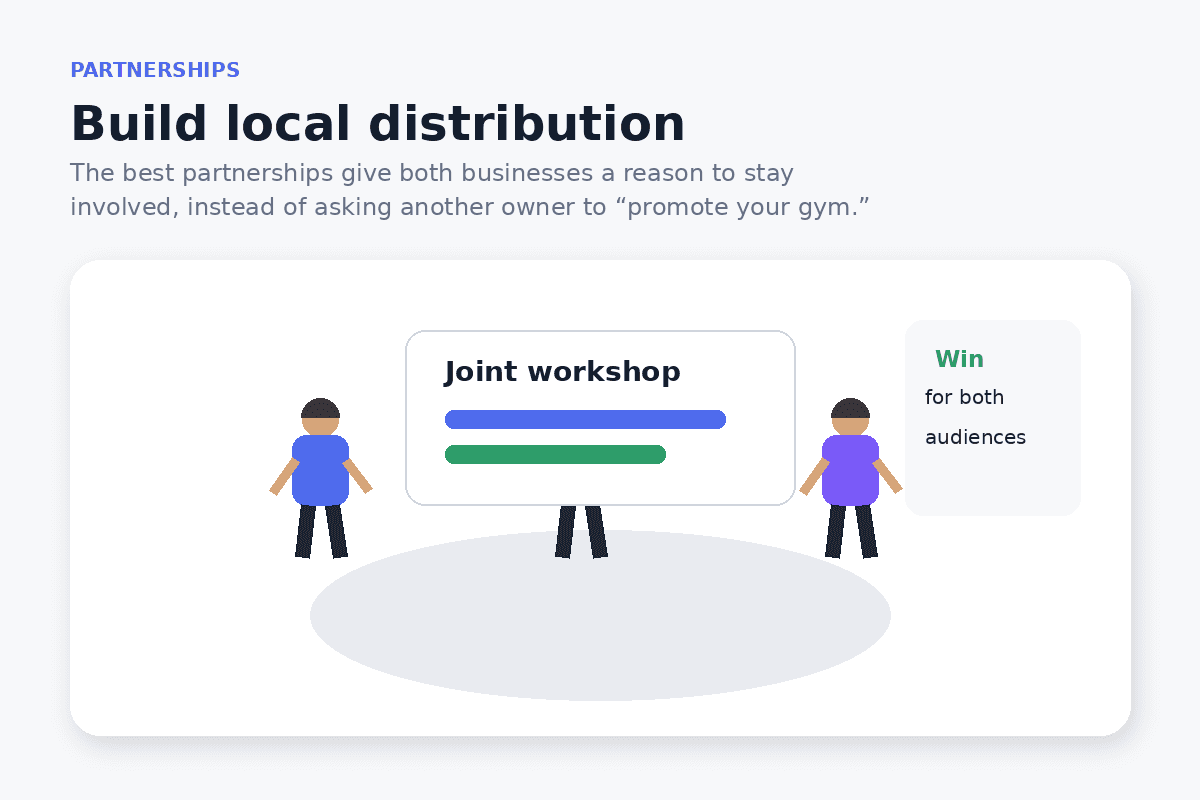
A gym could offer a mobility workshop to a local running club.
A martial arts school could run a free personal-safety workshop for staff at a nearby company.
A physical therapy clinic and strength gym could co-host an educational event for people returning to exercise after treatment, with appropriate professional boundaries.
The strongest partnership gives both businesses a reason to stay involved.
Start With One Partnership You Can Actually Maintain
You do not need twenty partnership agreements.
Choose one local business whose audience overlaps with yours.
Contact the owner or manager and propose something specific.
Instead of saying:
"We should work together sometime."
Try:
"We run beginner strength classes a few minutes from your running store. Would you be interested in hosting a joint workshop on strength training for runners? We could provide the coaching and handle registrations."
Agree on how the event will be promoted, who will collect registrations, and what participants can expect afterward.
Then measure the results before building the next partnership.
8. Run Community Events That Collect Real Leads
A local event can generate leads without looking like a membership sale.
Examples include:
- Beginner lifting workshops
- Self-defense classes
- Nutrition seminars
- Youth athletic clinics
- Charity workouts
- Mobility workshops
- Women's beginner training sessions
- Fitness assessments
- 5K preparation sessions
The mistake is hosting the event, meeting thirty people, and collecting contact details from nobody.
Registration should happen before the event.
Then attendees are already in your system.
Afterward, send something relevant:
"Thanks for coming to Saturday's beginner lifting workshop. If you want help putting this into practice, we're running two gym intro sessions next week. Want me to save you a spot?"
Useful. Specific. Connected to what they just attended.
Not:
"BUY A MEMBERSHIP TODAY — 15% OFF."
Choose Events That Attract Your Ideal Members
A gym focused on beginner strength training may get more useful prospects from an introductory lifting workshop than a competition designed for experienced athletes.
A martial arts school looking to grow its children's program may find that an introductory family event brings in more relevant inquiries than a general fitness challenge.
The event should introduce people to the kind of experience you actually sell.
Otherwise, you risk spending time organizing activities that attract attention but have little connection to your membership programs.
9. Create an Offer for Local Employers, Schools, or Teams
This will not fit every gym.
But when it does, one relationship can introduce you to dozens of potential members.
You could create:
Corporate fitness starter sessions — A local employer gives employees access to a scheduled beginner program.
Youth athlete strength workshops — Partner with sports teams during their off-season.
Teacher or healthcare-worker introduction week — Create a program around a local organization instead of running another broad discount.
The advantage is distribution.
Instead of trying to reach 100 people separately, you find one organization that already communicates with those 100 people.
Just make sure the offer makes economic sense.
A corporate discount that fills your busiest class with heavily discounted memberships may create a capacity problem rather than a growth opportunity.
Make the Group Offer Easy to Understand
A local employer does not need your entire membership catalog.
They need to know what you are offering, who it is for, what it costs, and how employees can participate.
Create a simple introductory package with clear dates, available spaces, and an easy registration process.
Then give the organization a short explanation it can share internally.
Make it easy for someone who has never visited your gym to understand exactly what happens when they sign up.
10. Make Content Around the Questions Prospects Actually Ask
A gym owner posts five Reels.
One gets 18,000 views. The others get 600.
The 18,000-view video produces zero inquiries.
Meanwhile, a simple video titled What Happens During Your First Class at Westside Strength gets 900 views and generates four DMs.
Which one worked?
Social media becomes much easier to judge once you stop confusing attention with leads.
Keep a list at the front desk.
Every time a potential member asks a question, write it down.
Soon you will have months of content.
Examples:
- Do I need to be fit before joining?
- What should I wear to my first class?
- Am I too old to start?
- What happens during a beginner session?
- How much does membership cost?
- Do I have to sign a long contract?
- Can complete beginners join?
- How often should I train?
- What happens if I miss classes?
- Can my child try a class first?
Then answer one question per video.
Do not overproduce it.
A coach standing in your actual gym explaining the answer clearly often tells a prospect more than a polished montage with dramatic music.
Show the Experience, Not Just the Exercise
A prospective member may already understand what a squat looks like.
What they do not know is what happens when they walk through your door for the first time.
Show your reception area.
Introduce your coaches.
Explain how beginners are welcomed.
Show how a class starts and what happens when someone needs extra help.
These details might seem ordinary to you because you see them every day.
To a person considering their first gym membership, they can answer the questions that are keeping them from booking.
11. Give Social Media Viewers a Specific Next Step
"Follow for more fitness tips" can grow an audience.
It does not necessarily generate local leads.
Give people something they can actually do.
For example:
"Never trained before? Book one of our beginner sessions here."
"Want to see whether the program suits your child? Message us 'TRIAL' and we'll send the next available times."
"We're running our next beginner lifting workshop Saturday. Registration is in the bio."
Specific calls to action also make your results easier to measure.
You can see which piece of content generated DMs, trial bookings, calls, or form submissions.
Likes are nice.
Members pay the rent.
Make Sure Someone Owns the Conversation
You publish a video and three people ask about your beginner classes.
One message arrives during the morning rush.
Another comes while your coaches are teaching.
The third arrives late in the evening.
Who responds?
If nobody is responsible for social media inquiries, the attention you worked to generate can disappear before anyone books a trial.
Decide which staff member monitors incoming messages, how inquiries are recorded, and how conversations move toward booking.
Do not let your Instagram inbox become a separate lead database that nobody checks.
12. Run Google Search Campaigns Around Strong Buying Intent
Paid ads deserve a place in your lead generation system.
They should not become the entire system.
If turning off Google Ads causes your pipeline to disappear overnight, you have built a dependency rather than a diversified acquisition system.
That does not mean ads are bad.
It means you should know exactly what you want them to do.
Search ads can put you in front of people actively looking for what you sell.
Good keyword themes might include:
- Gym near me
- Personal training near me
- CrossFit gym near me
- Boxing classes near me
- Beginner gym classes
- Kids martial arts near me
Send each group to the most relevant page.
Do not bid on "boxing classes" and drop somebody onto a homepage where boxing is hidden three menus deep.
Also watch geography carefully.
A cheap lead twenty miles away may be much less useful than a more expensive lead five minutes from your gym.
Measure enrollments by campaign, not just form fills.
Check What People Are Actually Searching For
A search campaign can spend money on terms that look relevant but attract the wrong people.
Someone searching for free home workouts is not necessarily looking for a paid gym membership.
Someone searching for personal trainer certification may be looking for a career, not personal training sessions.
Review the search terms triggering your ads and exclude irrelevant searches where appropriate.
Keep your location targeting aligned with the area your members can realistically travel from.
The goal is not to appear in every fitness-related search.
It is to appear when someone who could become a member is looking for a gym like yours.
13. Use Meta Ads for One Clear Offer
Facebook and Instagram can generate gym leads.
But the person scrolling Instagram probably did not open the app intending to join your gym.
Your ad needs to create enough relevance for them to stop.
A vague message such as BECOME THE BEST VERSION OF YOURSELF could belong to almost any fitness business on earth.
A stronger campaign is usually much more specific:
New to strength training?
Join our four-session beginner introduction. Learn the basic lifts with a coach before entering regular group classes.
Now they know who it is for, what they get, why it exists, and what happens next.
The offer matters here.
So does the trade-off.
A completely free trial may create more inquiries but also more low-commitment registrations and no-shows.
A paid introductory program creates more friction but can filter for stronger intent.
There is no universal winner.
The right choice depends on your program, market, pricing, capacity, and sales process.
See our breakdown of free versus paid gym trials.
Measure the Quality of Leads From Each Campaign
Suppose one campaign generates 50 inquiries at $8 each.
Another generates 20 inquiries at $18 each.
The first looks cheaper.
But if the first campaign produces two memberships and the second produces six, the second campaign has a lower cost per enrolled member.
The numbers above are hypothetical, but the distinction matters.
Track the source of each inquiry through the trial and enrollment process.
Otherwise, you may keep increasing the budget for the campaign generating the most leads while overlooking the one producing more paying members.
14. Retarget People Who Already Showed Interest
Somebody visits your membership page.
Then their kid starts crying. Dinner needs cooking. Their phone rings.
They forget about you.
That does not necessarily mean the person rejected your gym.
Retargeting lets you stay visible to people who have already interacted with your business.
Depending on the platform, available tracking, consent, and applicable rules, you may be able to retarget:
- Website visitors
- Landing-page visitors
- People who watched your videos
- Previous leads where permitted
- People who engaged with social content
Do not show them the exact same ad forever.
Move the conversation forward.
First ad:
Beginner strength coaching in Denver.
Retargeting ad:
Wondering what your first session looks like? Watch this 40-second walkthrough.
Next:
Beginner introductions available Saturday at 10 a.m.
You are reducing uncertainty one step at a time.
Match the Message to What the Prospect Already Knows
Someone who has watched a video about your gym may still need to understand the program.
Someone who has already visited your trial booking page probably needs a different message.
For that second person, another general introduction to your gym may not be as useful as a reminder about available trial times or an explanation of what the first session involves.
Avoid treating every previous visitor as though they are ready to purchase.
Use retargeting to answer questions and make the next step easier.
15. Run a Lead Reactivation Campaign
Before you spend another $1,000 generating completely new leads, open your existing list.
You may already have hundreds of people who:
- Asked for information
- Downloaded something
- Booked but never attended
- Completed a trial
- Said "maybe next month"
- Stopped answering
- Attended an event
- Used to be members
Those people are not identical.
But they already know who you are.
Do not send:
"Hi, just following up again."
That gives the person no reason to respond.
Give the conversation a reason to restart.
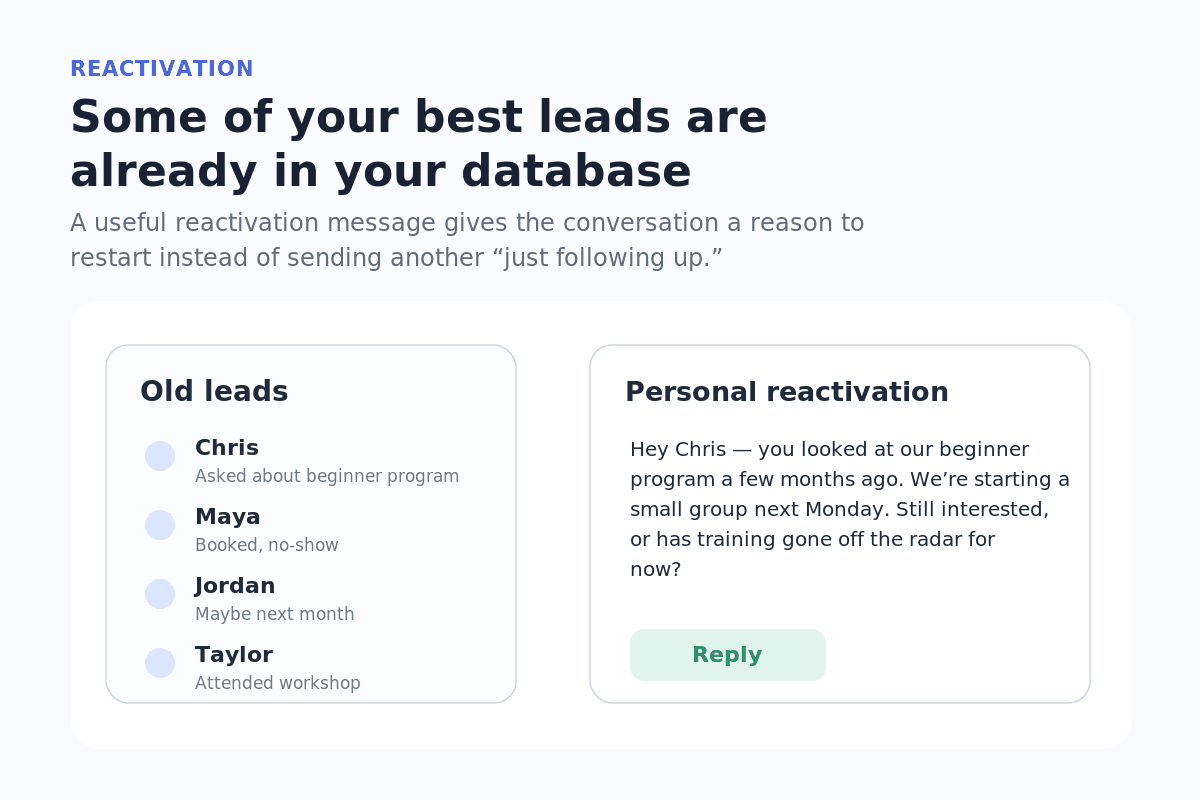
For example:
Hey Chris, Mike from Northside Strength here. You looked at our beginner program a few months ago but never ended up coming in. We're starting a small beginner group next Monday, so I thought I'd check before we fill it. Still interested in getting started, or has training gone off the radar for now?
That last sentence matters.
It allows a real answer.
Y
es. No. Not right now.
Any of those is more useful than another ignored "just checking in."
You can also build campaigns around a new beginner intake, a schedule change, a seasonal program, a new class, an upcoming event, or a specific challenge.
Segment Your Old Leads Before Contacting Them
Someone who completed a trial but never enrolled is not in the same position as someone who only requested a price list.
A former member who moved away may not be a useful reactivation prospect at all.
Separate your list into meaningful groups.
For example:
- Leads who never booked a trial
- Leads who booked but did not attend
- Trial participants who did not enroll
- Former members who may be interested in returning
Then write a message relevant to each group.
Do not repeatedly contact people who have opted out or who never gave you permission to receive the type of marketing you are sending.
In the United States, commercial email is subject to CAN-SPAM requirements, including accurate sender information and an opt-out mechanism.
See the FTC's CAN-SPAM compliance guide.
The Lead Generation Idea Is Only Half the Job
Imagine two gyms.
Gym A
Generates 60 leads.
Staff usually responds later that evening.
Nobody consistently records where each lead came from.
Trials are booked manually.
No-shows occasionally get contacted.
Eight people join.
Gym B
Generates 35 leads.
Every inquiry enters one pipeline.
The prospect immediately knows someone received their message.
Staff owns the personal follow-up.
The lead is offered two specific trial times.
Reminders go out before the appointment.
No-shows receive follow-up.
Every enrollment is traced to a source.
Ten people join.
These are hypothetical examples, but they illustrate a real operational problem.
A gym can generate fewer inquiries and still enroll more members if it handles those inquiries more consistently.
This is why acquisition and conversion cannot be treated as completely separate jobs.
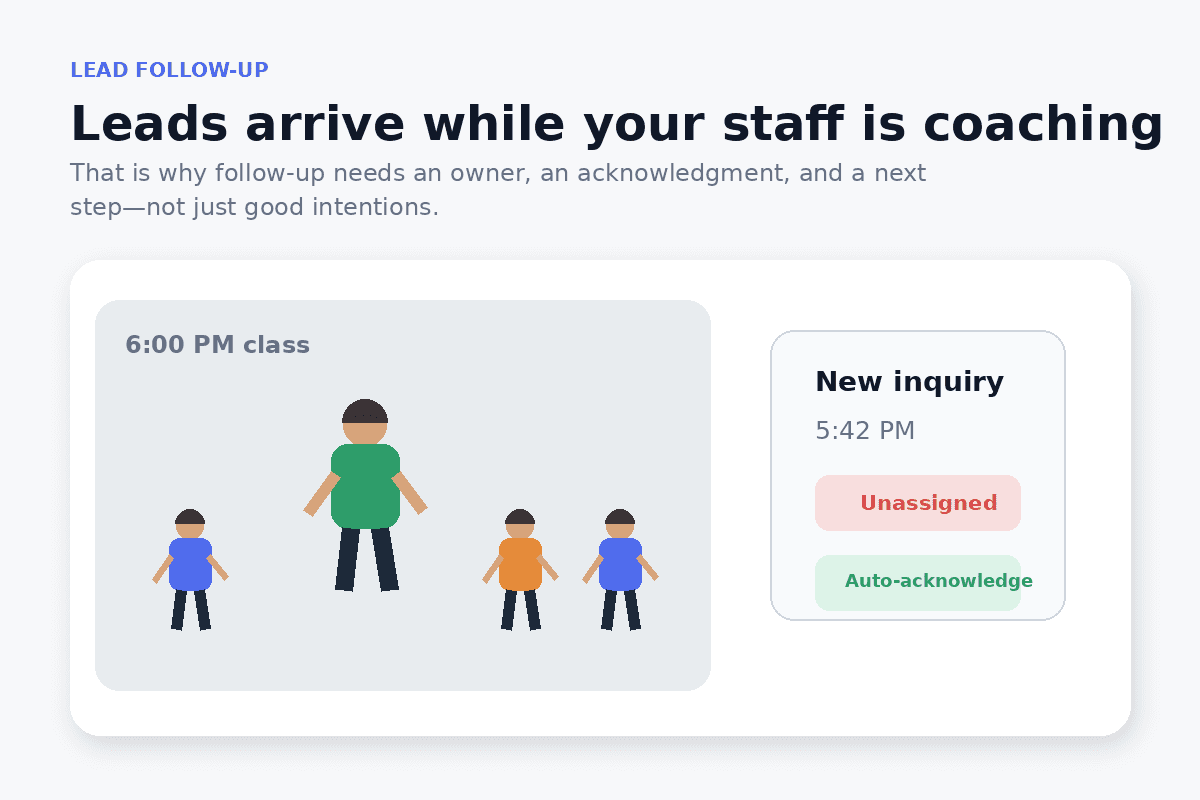
Respond While the Inquiry Is Still Fresh
Imagine someone fills out your form at 5
p.m.Unfortunately, your staff is running the 5
class.Nobody sees it until 8
.That is a completely normal operational problem.
It is also why lead follow-up needs a system.
Older web-lead research found a steep decline in contact and qualification odds as response times lengthened, particularly during the first hour.
That research was not gym-specific and should not be treated as a current fitness benchmark, but the operational lesson is still sensible: an inquiry is easier to continue while the person still remembers making it.
See the classic Lead Response Management Study and the related Harvard Business Review discussion.
At minimum:
- Capture the inquiry immediately.
- Confirm it was received.
- Tell the prospect what happens next.
- Give somebody responsibility for personal contact.
- Try more than one channel where you have permission.
- Keep following up until you receive an answer or reach the end of your process.
Automation is useful here.
It should keep a lead from being forgotten.
It should not turn your sales process into ten identical robotic messages.
Give the Lead One Obvious Next Step
Do not finish a conversation with:
"Let us know if you're interested."
You already know they are interested.
They contacted you.
Move them forward.
Try:
"I've got beginner introductions Tuesday at 6
or Thursday at 5. Which works better?"
That is much easier to answer.
The same applies when someone asks about price.
Do not panic and hide the number.
Do not dump a giant membership price sheet into the conversation either.
Understand what they are looking for, explain the relevant option, answer the question, then guide them toward the next useful step.
Monstro-X has a more detailed framework for handling gym pricing questions without killing the conversation.
Build a Process for Trial No-Shows
Someone books a trial but never arrives.
Your coach assumes they lost interest.
The lead stays in your database until somebody eventually deletes it.
But the person may have forgotten, had a scheduling conflict, or felt nervous about attending.
Give staff a consistent no-show process.
Record the missed appointment, make a friendly follow-up attempt, and offer a new time if the prospect is still interested.
You do not need to chase somebody indefinitely.
You do need a process that prevents a single missed appointment from becoming an automatic lost lead.
Track Which Lead Generation Ideas Actually Produce Members
You can generate cheap leads and still run an expensive marketing channel.
Imagine this hypothetical example.
| Channel | Leads | New Members | Spend | Cost per Lead | Cost per New Member |
|---|---|---|---|---|---|
| Campaign A | 40 | 4 | $600 | $15 | $150 |
| Campaign B | 18 | 6 | $540 | $30 | $90 |
Campaign A produces cheaper leads.
Campaign B produces cheaper members.
Which number pays your bills?
Track at least:
Leads by source — Where did inquiries come from?
Contact rate — How many leads actually entered a conversation?
Trial booking rate — How many booked?
Show rate — How many arrived?
Enrollment rate — How many became paying members?
Cost per enrolled member — How much did the channel really cost you?
Retention by lead source — Do members from one source stay noticeably longer than members from another?
That last number is easy to miss.
Suppose one promotion brings you twenty new members who cancel within three months.
Another brings eight people who stay for two years.
Lead volume alone tells you almost nothing about the long-term value of those channels.
Calculate Your Cost per Enrolled Member
Use this simple formula:
Cost per enrolled member = Total channel spend ÷ Members enrolled from that channel
For example, if you spend $600 on a campaign and enroll four members:
$600 ÷ 4 = $150 per enrolled member
This is a much more useful number than cost per lead when you are deciding where to spend your marketing budget.
You can go further later.
Start there.
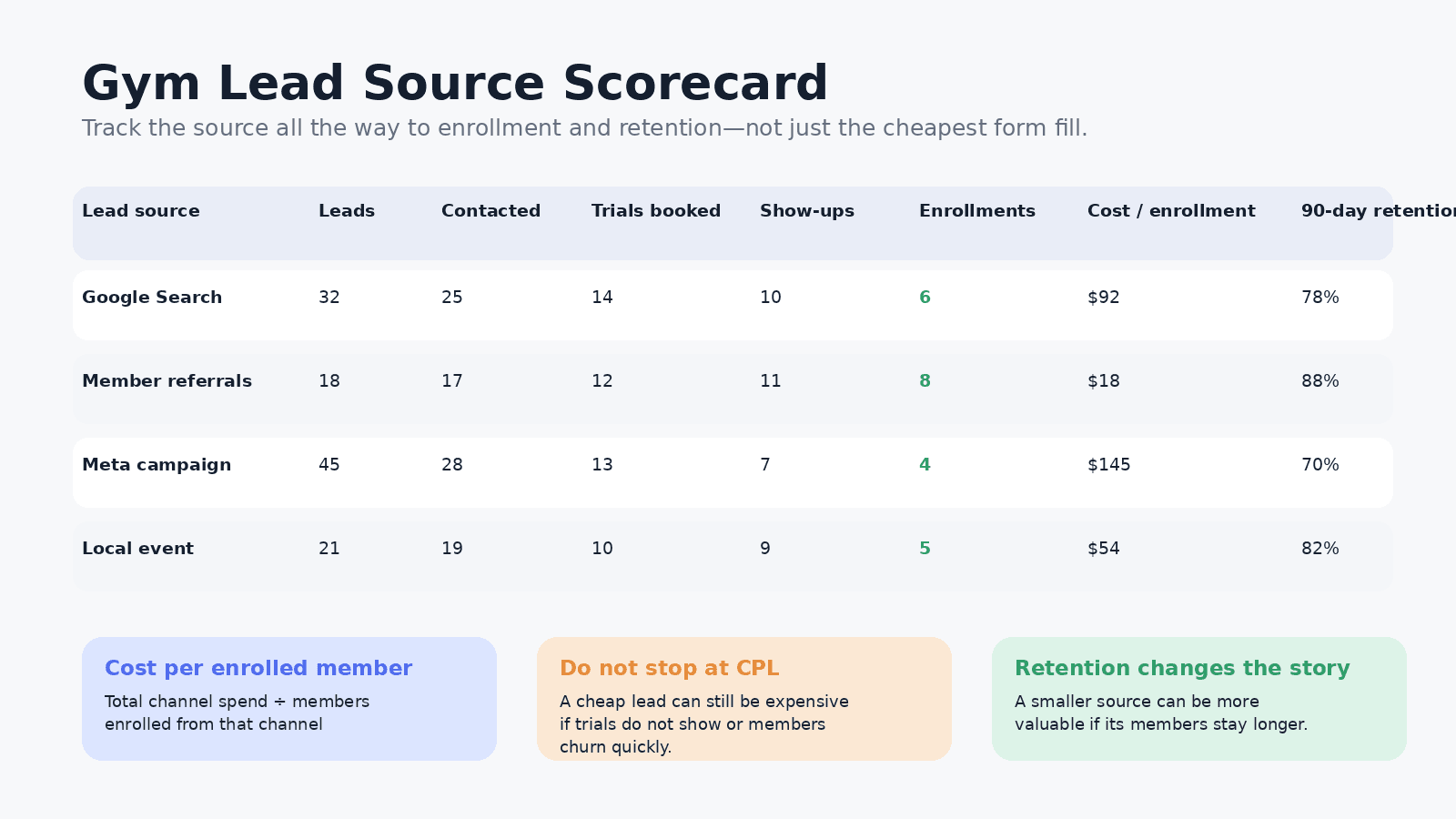
Zen Planner's lead-source tracking guidance similarly recommends tracking sources consistently and looking beyond lead volume to conversion quality.
Look Beyond the First Membership Payment
Acquisition cost is only one part of the picture.
You should also understand how long members from different sources tend to stay.
A campaign that produces low-cost enrollments may be less attractive if those members cancel quickly.
A referral program may produce fewer new members but bring in people who remain engaged for longer.
Track the numbers over time.
Do not assume one source produces better members simply because it feels more personal or delivers cheaper inquiries.
Let your actual membership data inform that decision.
Which Gym Lead Generation Ideas Should You Start With?
Do not leave this article and launch fifteen campaigns.
You will probably make all fifteen mediocre.
If your gym currently has very little lead flow, start with three areas.
1. Capture Existing Local Demand
Fix:
- Google Business Profile
- Reviews
- Core website pages
- Trial or consultation landing page
These are people already looking.
2. Build One Member-Driven Lead System
Choose:
- Structured referrals
- Bring-a-friend sessions
- Milestone invitations
Do it every month instead of running one referral contest and forgetting about it.
3. Add One Predictable Acquisition Channel
Depending on your business, that could be:
- Google Ads
- Meta ads
- Partnerships
- Community events
- Organic content
- Local outreach
Then measure it all the way to enrollment.
Once those three work, add another channel.
Not before.
A 30-Day Gym Lead Generation Plan
If your marketing currently feels scattered, use the next month to build the basic system instead of adding another random campaign.
Week 1: Fix the Front Door
Check your Google Business Profile.
Update your hours.
Replace poor photos.
Review your website on a phone.
Try to book a trial yourself.
See how many clicks it takes.
Make sure every form works.
Make sure somebody actually receives the inquiries.
Week 2: Fix Your Offer and Follow-Up
Choose the main next step you want a lead to take.
That could be:
- Free consultation
- Paid beginner program
- Free trial
- Assessment
- Intro session
Write the follow-up process.
Who replies?
How quickly?
What happens when someone does not answer?
What happens when they book?
What happens when they do not show?
Run that process manually before trying to automate every step.
Week 3: Activate Your Members
Choose one referral moment.
You could run a bring-a-friend class.
Recognize member milestones and invite friends.
Create simple referral rewards.
Give staff a clear way to record referrals.
Do not simply tell coaches, "Remember to ask for referrals."
That is not a system.
Week 4: Add One New Traffic Source
Now choose one.
Google Search. Meta. A local partnership. A community workshop. A content campaign.
Run it long enough to get useful data.
And record every lead source.
At the end of the month, do not ask:
"Which campaign got the most leads?"
Ask:
"Which campaign put the most good prospects into our sales process, and what happened to them afterward?"
That question will save you a lot of wasted marketing spend.
More Leads Are Useful. A Lead System Is Better.
There is nothing wrong with wanting more gym leads.
You need new people entering the business.
But lead generation works much better when every channel feeds the same operating system.
Someone discovers you.
They get a clear reason to raise their hand.
Their information is captured.
Your team responds.
They book.
They arrive.
They understand what happens next.
They enroll.
Then, if you give them a great experience, some eventually become the source of the next lead.
That is a healthier growth loop than constantly paying to refill the top of a funnel that leaks everywhere underneath.
Start with local demand.
Build referrals intentionally.
Use partnerships and events where they make sense.
Use paid ads for a clear purpose.
Reactivate the leads you already have.
Then track the result all the way to membership.
Software can make that system much easier to run.
Monstro-X includes referral tracking, member rewards, communication, attendance information, workflows, and reporting that can help owners turn member activity into repeatable growth systems rather than another spreadsheet somebody has to remember to update.
But start with the process.
Generating more leads into a broken process only makes the broken process busier.
Sources & References
- Google Business Profile Help — Tips to Improve Your Local Ranking on Google
- Google Business Profile Help — Tips to Get More Reviews
- FTC — CAN-SPAM Act: A Compliance Guide for Business
- Lead Response Management Study
- Harvard Business Review — The Short Life of Online Sales Leads
- Zen Planner — Fitness Lead Generation Best Practices
- Zen Planner — Track and Analyze Lead Sources for Your Gym
- PushPress — The Gym Marketing Plan: Website, SEO, and Lead Gen That Actually Work
- Glofox — The Gym Sales Funnel: From Lead to Loyal Member
- Gymdesk — Landing Pages & Lead Capture for Gyms
- Kicksite — The Ultimate Guide to Generating More Leads for Your Gym
- Mindbody — 15 Ways to Generate More Leads at Your Fitness Business