
SEO for Gyms: How to Get Found Locally
September 18, 2026
You can have the best coaching in town and still lose a prospect before they ever see your gym.
They search “gym near me,” “BJJ classes in Austin,” “CrossFit near me,” or “personal trainer in [city].”
Google shows a few local businesses.
Your gym is not there.
So the prospect never compares your coaching, your community, your schedule, or your offer. They compare the businesses they can see.
That is the real job of SEO for gyms.
It is not to collect traffic for the sake of traffic. It is to make your gym easier to find when a nearby person is already looking for what you offer, give them enough confidence to take the next step, and make that next step easy.
For a local gym, martial arts school, CrossFit box, yoga studio, or similar membership business, the system usually looks like this:
local search → visibility → trust → trial or inquiry → follow-up → enrollment
If any part of that chain is weak, rankings alone will not fix the business.
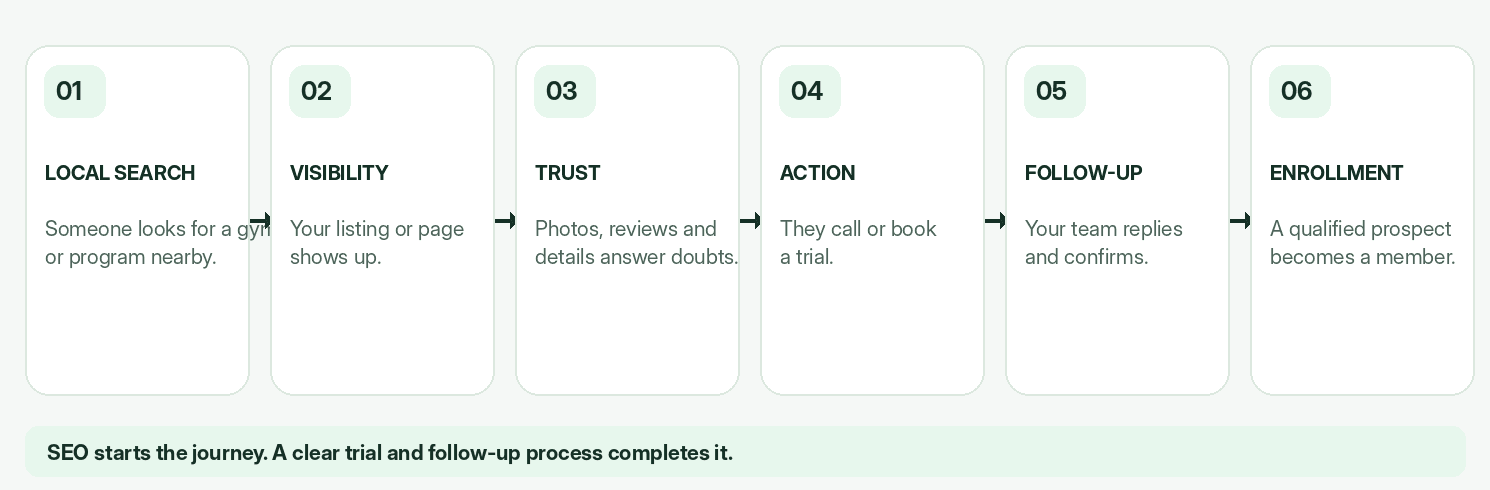
02. Gym SEO Search-to-Membership System: Gym SEO works best when search visibility is connected to a clear path from discovery to enrollment.
What SEO for gyms actually means
Search engine optimization is the work you do to help search engines understand your website and help the right people discover it.
For a gym, most of the highest-value searches are local.
A person looking for “strength training near me” does not need a gym 700 miles away. A parent searching “kids martial arts in Denver” is not looking for a national article about karate history.
They want a nearby business.
That is why gym SEO has two connected parts:
- Local visibility, especially your Google Business Profile and local map results.
- Website visibility, where individual pages rank for the programs, problems, and questions prospects search.
Google says local results are mainly influenced by relevance, distance, and prominence.
You cannot control where the searcher is standing. You can improve how clearly Google understands your business and how much trustworthy information exists around it.
The practical goal is simple:
Make it obvious to Google what your gym offers, where it is, and why it is a legitimate local business. Then make it obvious to the prospect why they should take the next step.
That is a better target than obsessing over one ranking position.
Start with local SEO before publishing dozens of blog posts
One of the easiest ways to waste time on gym SEO is to start with content.
An owner hears that blogging helps SEO, so they publish:
- 10 benefits of exercise
- best chest exercises
- why stretching matters
- how much water should you drink
- motivational fitness tips
None of those topics are necessarily bad.
But if your Google Business Profile is half-finished, your program pages are vague, your phone number is inconsistent, and your website barely explains where you are located, publishing another generic fitness article is not the first problem to solve.
Build the foundation first.
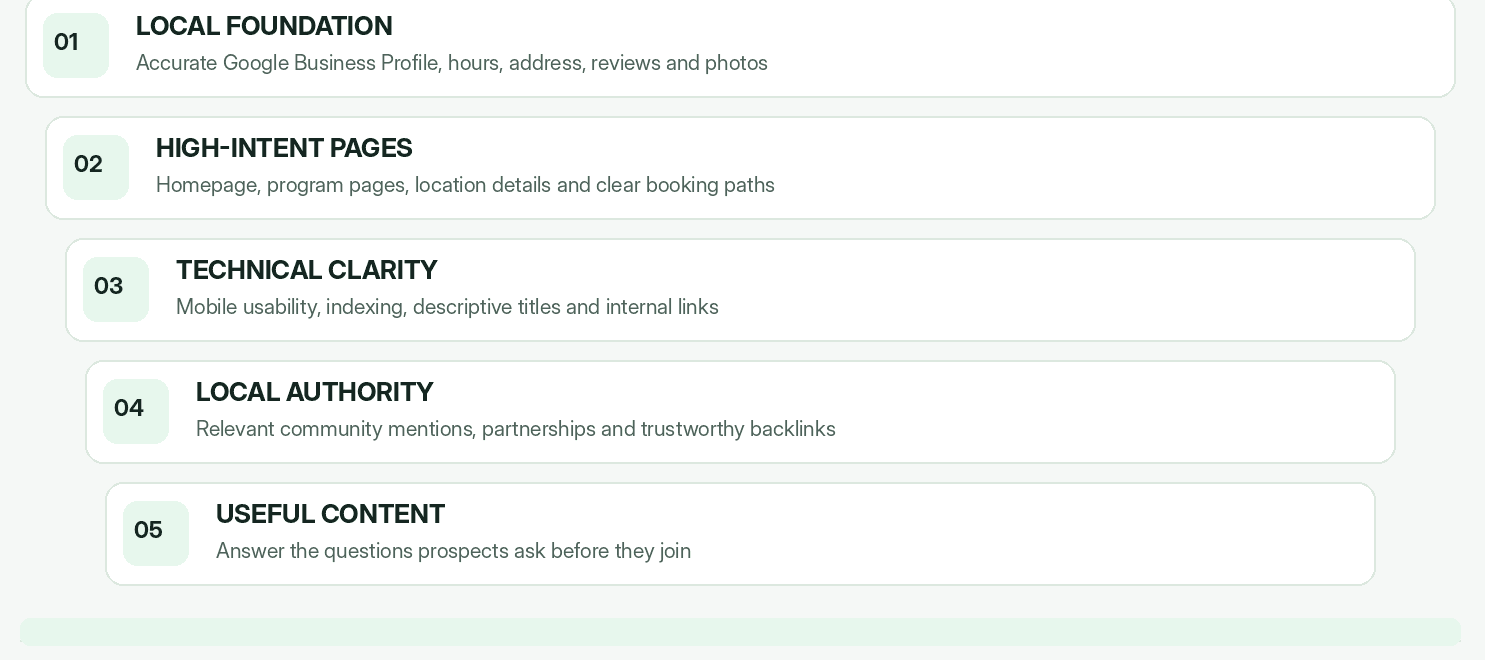
03. Gym SEO Priority Stack: Build upward. More content does not compensate for a weak local foundation.
A sensible order for most gyms is:
- Google Business Profile
- Accurate business information
- Core website and program pages
- Reviews and real-world trust signals
- Technical cleanup
- Local links and mentions
- Useful content based on real search intent
Once those pieces are working together, content becomes much more valuable.
1. Fix your Google Business Profile first
For many prospects, your Google Business Profile is the first impression of your gym.
They may see it before they visit your website.
They can see your:
- business name
- category
- location
- hours
- phone number
- reviews
- photos
- website link
- directions
- services
- updates
Google recommends keeping business information complete and accurate, responding to reviews, and adding useful photos and videos.
Use your real business name
Do not turn the business-name field into an SEO headline.
If your real name is Northside Strength, do not rename the profile:
Northside Strength Best Gym Personal Training Weight Loss Chicago
That is not branding. It is keyword stuffing.
Use the business name customers actually know.
Then use the rest of the profile and website to explain what you offer.
Choose the most accurate category
Your primary category helps Google understand the business.
Use the closest category to what you actually are.
A martial arts school should not choose a broad category just because it sounds bigger. A yoga studio should not pretend to be a general fitness center if that does not describe the business.
The clearer the category, the easier it is for Google to match the business with relevant searches.
Keep your hours current
This sounds small until someone drives across town for a 6
PM class and finds a locked door.Update normal hours.
Update holiday hours.
If the front desk is not staffed during every class, make sure your website still gives prospective members a realistic idea of when they can reach you or visit.
Add real photos
Use photos that help a nervous prospect understand what walking through the door will feel like.
Useful photos include:
- the outside of the building
- the entrance
- the training floor
- actual classes
- coaches
- equipment
- changing areas
- parking access
- beginner sessions
- kids classes, where relevant
A prospect deciding between two gyms is not only comparing equipment.
They are trying to answer:
Will I fit in here?
Real photos answer that better than polished stock photography.
Add the right website and booking links
Do not send every person to a generic homepage if a more useful page exists.
If someone finds your business because they are interested in Brazilian jiu-jitsu, a direct route to your BJJ program or trial page may make more sense.
Reduce the number of decisions between:
“I might try this.”
and:
“I booked.”
2. Build pages around what people actually want
Your homepage should not try to rank for every service you offer.
If your gym offers:
- group strength training
- personal training
- youth fitness
- nutrition coaching
- Olympic lifting
those are different offers.
They deserve enough space for Google and a prospect to understand them properly.
A useful program page answers the questions a real person would ask at the front desk.
For example, a personal training page should explain:
- who it is for
- what problems it helps solve
- what a first session looks like
- where training happens
- who the coaches are
- what times are available
- whether beginners are welcome
- how someone gets started
A kids martial arts page should explain:
- age range
- class schedule
- what parents should expect
- safety and supervision
- instructor background
- what children wear
- whether parents can watch
- how trials work
A CrossFit page should explain:
- whether beginners can join
- what onboarding looks like
- class structure
- schedule
- coaching
- scaling
- pricing or the process for getting pricing
- how to book an intro
This is SEO because it gives the page a clear subject.
It is also sales because it removes uncertainty.
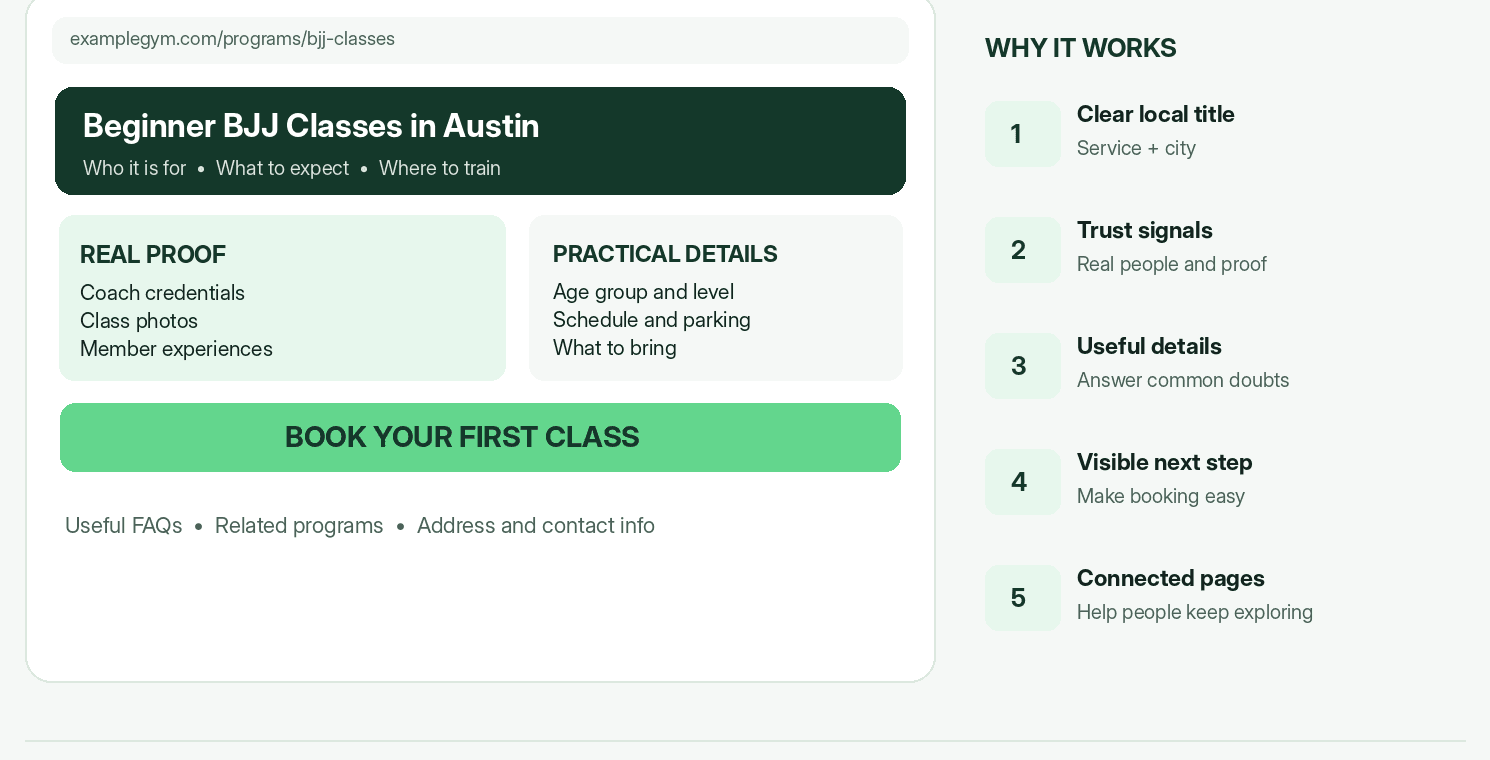
04. SEO-Friendly Gym Program Page Anatomy: A strong program page helps search engines understand the service and helps prospects decide whether it fits them.
Google recommends using the words people would use to find your content in important places such as titles and headings while still writing naturally.
So a title like:
BJJ Classes in Austin | Example Academy
makes sense.
Repeating “BJJ Austin best BJJ Austin classes Austin BJJ gym” through every paragraph does not.
3. Match keywords to intent, not just search volume
Keyword research becomes useful when you stop treating every keyword as equal.
A search like:
“what muscles does a deadlift work”
may have plenty of search volume.
But the person searching it may live anywhere and may have no intention of joining a gym.
Compare that with:
“powerlifting gym in Phoenix”
The second search may be smaller, but the commercial intent is much stronger.
For a local gym, useful keyword groups often include:
Core local searches
- gym in [city]
- gym near me
- fitness center in [city]
- martial arts school in [city]
- CrossFit gym in [city]
Program searches
- personal training in [city]
- BJJ classes in [city]
- kids karate in [city]
- kickboxing classes near me
- strength training in [city]
Decision-stage questions
- how much does a gym membership cost in [city]
- beginner BJJ classes in [city]
- best gym for beginners in [city]
- CrossFit vs regular gym
- what happens in a first martial arts class
Local problem searches
- gym with childcare in [city]
- early morning gym classes [city]
- women's kickboxing [city]
- teen fitness classes [city]
Your best keyword list is often hiding inside your sales conversations.
Write down what people ask before joining.
Look at form submissions.
Look at call notes.
Look at Google Search Console.
Look at the language people use in reviews.
Then build pages that answer those needs properly.
4. Do not create 40 thin city pages
This tactic looks attractive.
You serve one metro area, so you create:
- Gym in North Austin
- Gym in South Austin
- Gym in East Austin
- Gym in West Austin
- Gym in Round Rock
- Gym in Cedar Park
- Gym in Pflugerville
Then you copy the same page seven times and swap the city name.
That is not a local strategy.
It is a template.
Google's spam policies warn about doorway abuse, including substantially similar pages aimed at different cities that funnel users toward the same destination.
A real location page makes sense when you actually have a location there or when the page contains genuinely useful, location-specific information.
For example:
- a real address
- a unique schedule
- location-specific coaches
- parking details
- neighborhood access
- local testimonials
- location-specific photos
- programs that differ by site
If you have one gym, do not pretend you have seven.
Build one strong local presence.
5. Reviews are part of SEO and part of conversion
A review does two jobs.
First, it gives Google more evidence about the prominence and reputation of the business.
Second, it gives the prospect social proof.
That second job matters.
A person looking at your gym is trying to reduce risk.
They want to know:
- are beginners treated well?
- is the place clean?
- are coaches patient?
- is the culture intimidating?
- do parents trust the kids program?
- is the schedule reliable?
- does the business actually respond when there is a problem?
Reviews answer questions your own marketing cannot answer as convincingly.
Build a review process instead of occasionally begging for reviews
Do not wait until you remember.
Choose natural moments.
For example:
- after a member completes a first month
- after a student earns a milestone
- after a parent gives positive feedback
- after someone completes a challenge
- after a successful event
Then make the request easy.
Send a direct review link.
Keep the message short.
Do not tell people what rating to leave.
Do not pay, discount, or reward people in exchange for a positive review.
A simple request works:
“Glad to hear you're enjoying the classes. If you're comfortable sharing your experience, would you mind leaving us an honest Google review? It helps local people understand what training here is actually like.”
That is enough.
Reply to reviews
You do not need a corporate response template.
Thank positive reviewers like a human.
For negative reviews, avoid turning the reply into a public argument.
A calm response shows future prospects how the business handles problems.
6. Your website still has to work on a phone
A person can find you in Google, click the website, and leave ten seconds later.
SEO got the click.
The website lost the lead.
This is why technical SEO and conversion are connected.
Check your website from an ordinary phone, not from a desktop monitor.
Ask:
- does it load quickly?
- can I read the text without zooming?
- can I see the schedule?
- can I find the location?
- can I understand the programs?
- is the phone number tappable?
- can I book a trial without filling out a 14-field form?
- are popups blocking the page?
- does the menu work?
- do photos load properly?
You do not need to become a developer.
You do need to notice when the site is making a prospect work too hard.
7. Clean up the on-page SEO basics
Once the site has clear pages, make those pages easy for search engines to interpret.
Give every important page a useful title
Bad:
Home | Northside
Better:
Strength Training Gym in Denver | Northside Strength
Do not force the city into every title if it makes no sense, but make important local pages descriptive.
Use one clear main heading
A program page should have a clear H1.
For example:
Beginner Brazilian Jiu-Jitsu Classes in Tampa
The rest of the page can use H2 and H3 headings to organize:
- what to expect
- schedule
- coaches
- FAQs
- trial information
Write a useful meta description
A meta description should help someone decide whether to click.
Example:
Beginner-friendly BJJ classes in Tampa for adults and teens. See the schedule, meet the coaches, and book your first class at Example Academy.
It does not need every keyword variation.
Use descriptive internal links
Instead of:
click here
use:
see our beginner BJJ program
or:
learn how our free trial works
Internal links help people move through the site and help search engines understand how pages relate.
Optimize images sensibly
Use descriptive filenames where practical.
Compress large image files.
Add accurate alt text.
Put important images near relevant text.
8. Add LocalBusiness structured data, but do not treat schema like magic
Structured data is code that gives search engines a standardized description of information on a page.
For a physical gym, Google's LocalBusiness documentation recommends using the most specific subtype that fits, such as HealthClub where appropriate.
Useful information can include:
- business name
- address
- phone number
- opening hours
- URL
- image
This can make your business information clearer to Google.
It does not guarantee a ranking increase.
It does not replace a good Google Business Profile.
It does not make thin content useful.
Think of structured data as clear labeling.
If the rest of the box is empty, a better label does not solve the problem.
9. Build local links that make sense in the real world
Backlinks still matter, but gym owners often make this more complicated than necessary.
You do not need 5,000 random links.
You want relevant mentions from real websites.
Start with relationships that already exist around the gym.
Potential sources include:
- local chambers of commerce
- business associations
- charity partners
- local events
- competitions
- sports clubs
- schools
- community organizations
- health professionals you genuinely work with
- local news coverage
- landlord or shopping-center directories
- equipment partners
- sponsors
For example, if your gym runs a charity deadlift event, the event calendar, charity, local newspaper, sponsors, and participating organizations may all have a legitimate reason to mention and link to the event.
That is much stronger than buying a package of 300 directory links from a stranger.
A good link usually has a reason to exist even if Google disappeared tomorrow.
10. Publish content that supports membership decisions
Your gym does not need to become a general fitness magazine.
The internet already has enough articles called:
“7 Best Ab Exercises.”
Instead, publish content close to the questions a future member asks.
For a martial arts school:
- What happens in your first BJJ class?
- Is BJJ safe for beginners over 40?
- What should a child wear to their first karate class?
- How often should a beginner train?
- BJJ vs kickboxing: which is a better fit?
For a gym:
- Group training vs personal training: which should you choose?
- What happens during a gym consultation?
- How many strength sessions should a beginner do each week?
- Can you join a strength gym if you have never lifted?
- What should you expect from your first month?
For a CrossFit box:
- Do you need to be fit before starting CrossFit?
- What happens in an intro or foundations class?
- How are workouts scaled for beginners?
- CrossFit vs a regular gym membership
Those topics do three things at once:
- They answer questions people search.
- They remove objections before a sales conversation.
- They give your service pages useful internal links.
That is content with a job.
11. Connect SEO traffic to a trial process
This is where a lot of gym SEO advice stops too early.
Imagine you rank well.
A prospect clicks.
They read the page.
They fill out a form at 7
PM while your coaches are teaching.Then nothing happens until the next afternoon.
By then, they have contacted two other gyms.
The SEO worked.
The process after the lead did not.
Monstro-X has written about this same problem from the conversion side in Ton of Leads On Your Website But No Enrollments: Stop Blaming Quality.
A website lead is not the same thing as a completed enrollment.
Your organic lead process should define:
- Who receives the inquiry.
- How quickly they respond.
- What message gets sent first.
- What happens if the prospect does not reply.
- How the trial is booked.
- What reminder gets sent.
- What happens after the trial.
- When the lead is marked lost.
Software can help once the process is clear.
Automation is useful when it makes a good process more consistent.
It is not useful when it automates confusion.
12. Measure SEO by memberships, not vanity metrics
Rankings matter.
Traffic matters.
Impressions matter.
But none of them pay the rent by themselves.
Your SEO reporting should connect search activity to the business outcome.
Google Search Console shows data such as search queries, pages, impressions, and clicks.
Use that information to learn what Google already associates with your site and where people are finding you.
Then connect it to your lead and sales data.
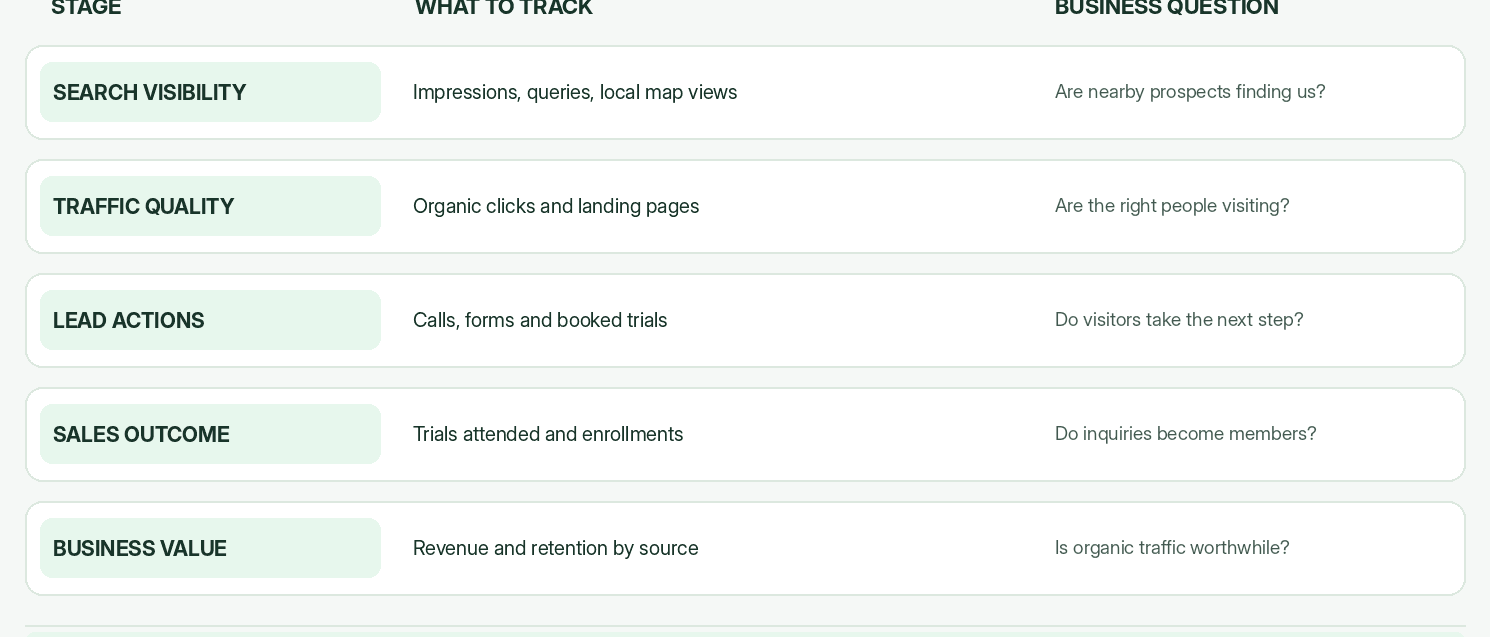
05. Gym SEO Measurement Scorecard: Rankings help diagnose performance. Trials and memberships show whether SEO is creating business value.
A simple monthly scorecard might include:
| Stage | What to track |
|---|---|
| Visibility | Organic impressions, relevant queries, local map visibility |
| Traffic | Organic clicks, top landing pages |
| Leads | Calls, forms, trial bookings, direction requests |
| Trials | Booked trials and attended trials from organic leads |
| Sales | New memberships attributed to organic search |
| Value | Revenue and retention of organic-origin members |
This lets you spot the real problem.
Example
Suppose a program page gets:
- 1,800 impressions
- 140 clicks
- 2 inquiries
The problem may not be rankings anymore.
The page may be attracting the wrong search intent, hiding the call to action, or failing to answer the questions prospects care about.
Now suppose another page gets:
- 500 impressions
- 55 clicks
- 12 inquiries
- 8 booked trials
- 5 new members
That smaller page may be much more valuable.
Traffic without intent can make an SEO report look good while the front desk stays quiet.
A 90-day SEO plan for a gym
Do not try to fix everything in one weekend.
Build the system in order.
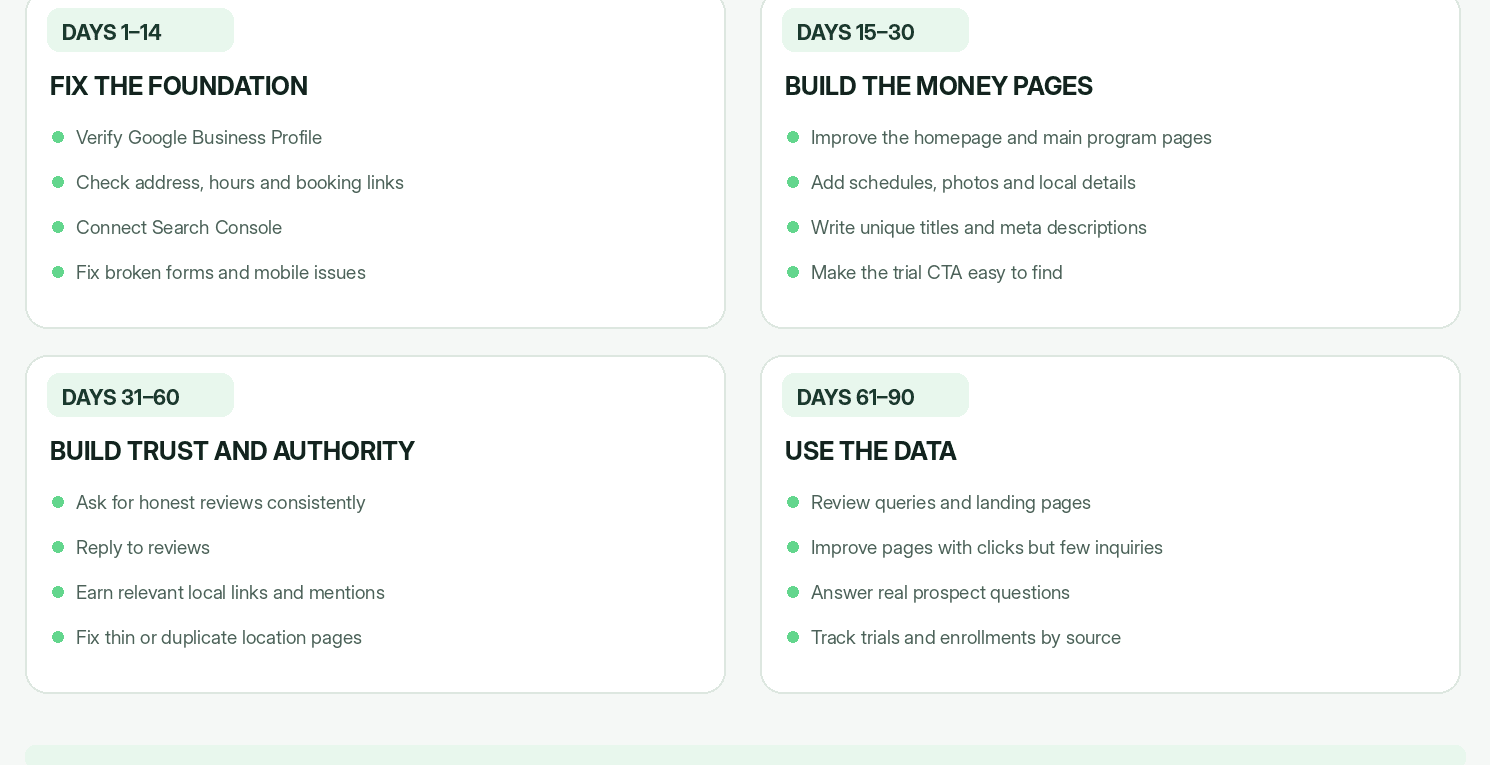
06. 90-Day Gym SEO Roadmap: A practical sequence for building gym SEO without turning it into another full-time job.
Days 1–14: fix the foundation
- Claim and verify your Google Business Profile.
- Check business name, address, phone, category, hours, website, and booking links.
- Add current real-world photos.
- Connect Google Search Console.
- Confirm important pages are indexable.
- Check the site on a phone.
- Fix broken forms, broken links, and obvious speed issues.
Days 15–30: improve the pages that make money
- Rewrite the homepage around the gym's real offer and location.
- Create or improve pages for the main programs.
- Add schedules, coach information, real photos, location details, and a clear next step.
- Write unique page titles and meta descriptions.
- Add useful internal links.
- Add appropriate LocalBusiness structured data.
Days 31–60: build trust and local authority
- Start a consistent review-request process.
- Reply to new reviews.
- Check important directory listings for accurate business information.
- Ask real local partners for relevant mentions where appropriate.
- Look for local event, sponsor, association, or press opportunities.
- Remove or improve weak duplicate location pages.
Days 61–90: use the data
- Review Search Console queries.
- Find pages getting impressions but weak click-through.
- Find pages getting traffic but few inquiries.
- Improve titles, page copy, photos, offers, and calls to action.
- Publish two or three pieces of content based on actual prospect questions.
- Track which organic leads become trials and members.
Then repeat.
SEO is not a one-time setup.
But it also should not become an endless checklist.
Once the foundation is solid, most of the work is:
observe → improve → publish what is actually useful → measure the result
Common gym SEO mistakes
Chasing rankings with no conversion path
A ranking is not useful if the page gives the prospect nowhere obvious to go next.
Every important local or program page should have a clear action.
Publishing generic fitness content
If a national health site can answer the topic better than you, ask why your gym is publishing it.
Your advantage is local experience.
Use it.
Copying location pages
Changing the city name in the same 600-word template is not a real local strategy.
Buying cheap backlinks
A pile of irrelevant links is not local authority.
Real relationships usually produce better opportunities.
Ignoring reviews until there is a problem
A steady review process is easier than a desperate push every six months.
Measuring only website traffic
Track the path to trials and memberships.
Treating SEO and sales as separate systems
The person who found you through Google still needs a response, a trial, a follow-up, and a reason to join.
SEO creates an opportunity.
Your operating system has to convert it.
Where Monstro-X fits
SEO helps a local prospect discover your gym.
After that, the job changes.
You need to capture the inquiry, move the prospect toward a trial, enroll the right people, and keep them engaged after they join.
That is where gym management and member systems become relevant.
Monstro-X gym management software is built around the parts that happen after someone enters your business: memberships, attendance, communication, engagement, referrals, community, rewards, and reporting.
If your immediate problem is visibility, fix the SEO foundation first.
If the gym is getting found but leads are not becoming members, read why website leads fail to enroll.
If acquisition is working but members are leaving too quickly, see how to increase gym membership retention.
And if your site looks polished but does not create action, the same principle applies from what actually matters on a martial arts school website.
The page has a job to do.
SEO for gyms: the bottom line
A good gym SEO strategy is not complicated because it has hundreds of tricks.
It is difficult because several basic things have to stay aligned.
Google needs to understand:
- what you offer
- where you are
- which pages matter
- whether the business appears legitimate and established
Prospects need to understand:
- whether the gym is for them
- what the experience looks like
- whether they trust you
- what to do next
And your staff needs to know:
- who owns the lead
- how the trial gets booked
- what happens after the inquiry
- how enrollment gets tracked
Get those pieces right before chasing clever tactics.
You do not need to “beat Google.”
You need to make your gym easier to understand, easier to trust, and easier to join.
That is what useful SEO looks like.
Frequently Asked Questions
How long does SEO take for a gym?
There is no fixed timeline.
A gym with an incomplete Google Business Profile and weak program pages may see early improvements after fixing basic issues, while competitive local markets and newer websites can take longer.
Treat SEO as an ongoing channel rather than a one-time campaign.
Is local SEO more important than blogging for a gym?
For most location-based gyms, local foundations should come first.
A complete Google Business Profile, strong program pages, accurate business information, reviews, and a usable website usually matter before a large blogging program.
Content becomes more useful once those foundations are in place.
Should a gym create a page for every city nearby?
Only when the page is genuinely useful and reflects a real location, service area, or distinct local offering.
Creating many near-identical city pages purely to rank can create a poor user experience and may fall into doorway-page territory.
Do Google reviews help gym SEO?
Google says reviews and ratings can contribute to local prominence, and reviews also help prospects evaluate a business.
Ask for honest reviews consistently, but do not manipulate ratings.
What are the most important keywords for a gym?
Usually the highest-value terms combine a service with local intent, such as:
- gym in [city]
- personal training in [city]
- BJJ classes near me
- kids karate in [city]
- strength training in [city]
The right keywords depend on your actual programs and the questions prospects ask before joining.
Does a gym need an SEO agency?
Not necessarily.
An owner or staff member can handle many fundamentals:
- Google Business Profile
- reviews
- useful program pages
- internal links
- Search Console
- local partnerships
A specialist can help when technical issues, competitive markets, site migrations, or multi-location SEO make the work more complex.