
Business Plan for a Gym: A Practical Guide + Example

September 18, 2026
You can have a good location, experienced coaches, solid equipment, and a gym people genuinely enjoy.
Then six months after opening, you discover the business needs 280 members to cover its bills.
The building only works comfortably with 180.
That is the kind of problem a business plan is supposed to uncover before you sign a lease, order equipment, or hire a full team.
A business plan for a gym is not mainly about producing a polished document for a bank. It is about proving that the business works on paper before you ask it to work in real life.
At a minimum, your plan should answer five questions:
- Who exactly is this gym for?
- What will those people buy?
- How will you consistently turn local demand into paying members?
- What will it cost to deliver the experience you are promising?
- How many members do you need before the gym supports itself?
Those questions matter more than whether your mission statement takes half a page or three sentences.
The U.S. fitness market itself is not short on demand. The Health & Fitness Association reported that 81 million Americans held a fitness-facility membership in 2025, representing 26.1% of the U.S. population aged six and older. Nearly 7 billion facility visits were recorded during the year.
But national demand does not prove that your 4,000-square-foot strength gym, Pilates studio, boxing club, or group-training concept will work in your neighborhood.
That is what the business plan needs to test.
What should a gym business plan include?
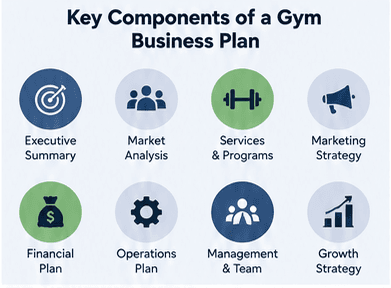
Most traditional gym business plans use familiar sections: an executive summary, company description, market analysis, services, marketing and sales, operations, management, funding, and financial projections.
That broadly matches the structure recommended by the U.S. Small Business Administration and the format used in current gym-business-plan guidance from fitness-industry software companies.
That structure is fine.
The mistake is treating the sections like a school assignment.
Your market analysis should affect your pricing. Your pricing should affect your revenue forecast. Your class capacity should affect how many memberships you can realistically sell. Your retention assumptions should affect how many new members you need every month.
If those pieces do not connect, you do not really have a business plan. You have several documents sitting next to each other.
A useful gym business plan normally covers these nine areas:
| Section | What it needs to answer |
|---|---|
| Executive summary | What are you opening, for whom, where, and why does the model make sense? |
| Gym concept | What type of gym are you building and what problem does it solve? |
| Market analysis | Is there enough local demand, and what alternatives already exist? |
| Services and pricing | What will members buy and how much revenue can each service produce? |
| Marketing and sales | Where will leads come from and how will they become members? |
| Operations | How will the gym actually run each day? |
| Staffing and management | Who owns coaching, sales, administration, cleaning, and member follow-up? |
| Financial plan | What does opening cost, what does operating cost, and where is break-even? |
| Funding and milestones | How much capital is needed, where will it come from, and what has to happen next? |
The rest of this guide shows how to build each section around decisions rather than filler.

1. Start with the gym model, not the logo
A surprising number of gym plans begin with branding.
Name ideas. Colors. Logo concepts. Taglines.
Those things matter eventually.
They just do not tell you whether the business works.
Start by defining the operating model.
A 24-hour access gym with 800 members behaves very differently from a semi-private training gym with 110. A boxing club, martial arts school, Pilates studio, CrossFit affiliate, and large multipurpose health club may all sell “fitness,” but their economics are not remotely identical.
Write down:
What type of facility are you opening?
Open gym, boutique studio, group training, semi-private coaching, personal training, martial arts, CrossFit, yoga, Pilates, boxing, or a hybrid model?
Who is it built for?
Busy professionals? Parents? Competitive athletes? Beginners? Adults over 50? Families? Women? Youth athletes?
What are they actually buying?
Equipment access? Coaching? Accountability? A structured training program? Community? Skill development? Convenience?
Why would they choose you over the options already nearby?
Avoid vague positioning such as:
> We provide high-quality fitness in a welcoming community.
Almost every gym can say that.
A useful concept is more specific:
> A coaching-led strength gym for adults aged 35–55 who want to get stronger but do not feel comfortable training alone in a traditional commercial gym.
That statement immediately influences equipment, staffing, schedule, pricing, facility size, marketing, and sales.
Your concept should make those decisions easier.
2. Research the market before you fall in love with a location

A national fitness-industry statistic can tell you the market exists.
It cannot tell you whether another gym is needed two blocks from your proposed location.
The SBA recommends combining market research and competitive analysis so you can understand potential customers and existing alternatives before committing capital.
For a gym, that research should be local.
Start with the realistic trade area around the facility. Depending on the concept and market, that might be a neighborhood, a set of ZIP codes, or a practical driving radius.
Then investigate four things.
Local demand
Who lives or works nearby?
Look at population, age, household income, employment patterns, family composition, residential growth, and daytime population where relevant.
Do not stop at demographics.
Ask whether those people behave like your likely member.
A neighborhood full of young professionals may look attractive for a premium boutique concept. But if most residents commute an hour each way and the area empties during the day, your class schedule needs to reflect that.
Direct competitors
Visit them.
Do not just collect website screenshots.
Look at:
- membership prices
- joining fees
- class schedules
- reviews
- facility quality
- parking
- equipment
- coaching model
- trial offer
- opening hours
- target audience
- how quickly they answer inquiries
- how busy different time slots appear
You are not trying to prove competitors are bad.
A strong competitor may actually validate the market.
The useful question is whether there is room for a different or better-defined offer.
Indirect competitors
Your member is not only choosing between your gym and another gym.
They may choose a home setup, running club, recreational sport, personal trainer, fitness app, community center, yoga studio, martial arts school, or simply do nothing.
Your plan should reflect the alternatives competing for the same time and money.
Evidence of demand
Look for actual signals.
Are competing classes regularly full? Are local gyms expanding? Are people searching for the type of training you offer? Are nearby residents asking for specific services in local groups? Are employers or schools potential partners?
A spreadsheet saying “the fitness market is growing” is weak evidence.
A waitlist of 80 local people who have already registered interest is much stronger.
3. Build the offer and pricing around capacity

A gym owner can look at a competitor charging $149 per month and decide:
> We will charge $139 so we are more competitive.
That is backwards.
Price should come from your model.
Imagine a coaching-led facility has room for 14 people per class.
It runs five prime-time classes per weekday.
That gives you 70 prime-time spots per day.
If the average member attends three times per week, the facility has a very different practical capacity from a 24-hour gym where 500 members rarely arrive at the same time.
Your pricing has to support the capacity you actually have.
Start by defining each revenue stream.
That might include:
- monthly memberships
- limited-frequency memberships
- personal training
- semi-private training
- drop-ins
- introductory programs
- youth programs
- nutrition coaching
- workshops
- merchandise
- events
- online programming
Then ask how much each one contributes.
Do not assume every revenue stream deserves equal attention.
A retail shelf bringing in $1,200 a month may look nice in the plan, but it should not distract you from a membership model producing $35,000 in recurring revenue.
Keep pricing understandable
Too many membership choices create operational and sales friction.
You may discover that three clear plans are easier to explain and manage than eleven combinations of session limits, discounts, contract terms, access levels, and add-ons.
The plan should also explain why your pricing fits the offer.
A premium coaching model should not be priced like basic equipment access unless the numbers still work.
And a low-price model normally needs enough capacity and member volume to support that decision.
If leads regularly ask about pricing, plan how the conversation should work rather than leaving every staff member to improvise. Monstro-X has a separate guide on handling gym pricing questions without killing the conversation.
4. Turn marketing into a sales forecast

“Run Facebook ads and post on Instagram” is not a marketing plan.
Neither is:
> We will grow through word of mouth.
Your business plan needs to show how people move from not knowing you exist to paying you every month.
For many gyms, the path looks something like:
Local awareness → inquiry → contact → consultation or trial → attendance → enrollment → onboarding → retained membership
Each stage has a number attached to it.
Here is a hypothetical example:
| Stage | Monthly example |
|---|---|
| Leads | 80 |
| Leads successfully contacted | 60 |
| Trials or consultations booked | 36 |
| Prospects who show up | 27 |
| New memberships sold | 15 |
| Existing members who cancel | 8 |
| Net member growth | 7 |
Those numbers are examples, not industry benchmarks.
Their value is that they force the model to make sense.
If your financial forecast requires 20 new members every month but your marketing plan only generates enough leads to support eight, you have found the problem early.
That is exactly what a business plan should do.
Separate lead generation from conversion
More leads will not fix a weak sales process.
A gym can spend another $2,000 per month on advertising while staff continue replying to inquiries six hours later, forgetting follow-ups, and losing people who never make it to a trial.
Your plan should define:
- lead sources
- expected marketing spend
- who responds to inquiries
- target response process
- how prospects book
- trial or consultation format
- follow-up process
- enrollment process
- referral system
For a deeper look at this part of the funnel, see Monstro-X's article on why website leads often fail to become enrollments.
If you plan to use a trial offer, decide whether free or paid fits your model rather than assuming the lower-friction option is automatically better. The free-trial vs. paid-trial guide explains the trade-off.
5. Write the operations section like somebody else has to run the gym
A weak operations plan says:
> The gym will be open Monday through Saturday and provide exceptional customer service.
A useful one tells you what actually has to happen.
Think through a normal Tuesday.
Who opens the facility?
Who handles the 6 a.m. class?
Who answers a new lead that arrives while the coach is teaching?
Who cleans the bathrooms?
Who checks failed payments?
Who notices that a new member has not attended in ten days?
Who closes the building?
Who covers when a coach is sick?
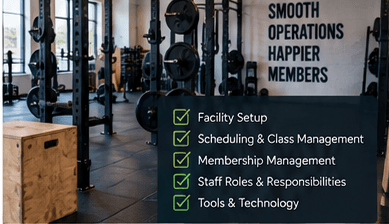
Your operations plan should cover the systems that keep the business moving, including scheduling, staffing, cleaning, facility maintenance, billing, check-in, lead management, member communication, incident procedures, inventory, equipment servicing, and reporting.
Also include the boring costs.
They are often the expensive ones.
Rent, common-area charges where applicable, payroll, utilities, payment processing, insurance, software, cleaning, repairs, music licensing where required, professional fees, internet, security, marketing, and equipment replacement all need somewhere to live in the plan.
Do not assume the owner will simply “handle everything.”
That works until the owner is coaching 25 hours a week, answering leads between classes, chasing payments at night, cleaning on Sundays, and trying to run marketing from a phone.
If a task exists, somebody should own it.
6. Put retention inside the business plan, not outside it
This part is commonly underdeveloped.
Owners forecast how many members they will sign up.
Then they quietly assume most of them will stay.
But retention changes the entire financial model.
Suppose Gym A signs 20 new members per month and loses 18.
Gym B signs 14 and loses six.
Gym A looks better on a lead-generation dashboard.
Gym B is adding members much faster.
Your business plan should therefore explain what happens after someone joins.
At minimum, define:
- the first 30–90 days
- attendance expectations
- early member check-ins
- progress milestones
- how attendance drops are noticed
- who follows up
- cancellation and freeze procedures
- how cancellation reasons are recorded
- referral moments
- how member feedback is collected
The point is not to predict retention perfectly before the doors open.
You cannot.
The point is to stop treating cancellation as something that mysteriously happens in the financial spreadsheet.
Your member experience is part of the economics.
Monstro-X's guide to increasing gym membership retention goes deeper into onboarding, attendance changes, progress, community, and retention ownership.
Referrals deserve the same treatment. Happy members may refer friends, but relying on that happening naturally is not much of a growth strategy. A stronger plan creates specific moments where sharing the gym feels natural. See why happy members do not automatically create more referrals.
7. Build the financial plan from the bottom up
This is the section that turns a gym idea into a business.
The SBA recommends calculating startup costs before launch because those numbers help estimate profit, perform break-even analysis, and determine funding needs.
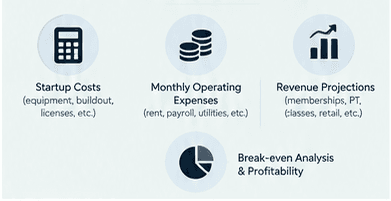
Start with four separate numbers:
Startup cost — What must be spent before opening.
Monthly operating cost — What the gym costs to run after opening.
Break-even point — The revenue or membership level where operating revenue covers operating cost.
Cash runway — How much money remains available while the gym grows toward break-even.
Do not lump them together.
Example startup budget
Imagine a hypothetical 4,500-square-foot coaching-led gym.
Its startup budget might look like this:
| Startup item | Example amount |
|---|---|
| Lease deposit, legal and setup | $18,000 |
| Build-out and improvements | $60,000 |
| Training equipment | $70,000 |
| Furniture, signage and access systems | $12,000 |
| Licenses, professional fees and initial insurance | $5,000 |
| Pre-opening payroll and staff training | $10,000 |
| Launch marketing | $12,000 |
| Website, software and IT setup | $5,000 |
| Initial working capital | $60,000 |
| Contingency | $20,000 |
| Total | $272,000 |
These are hypothetical numbers.
Your lease, build-out, equipment needs, city, staffing, and facility type could produce a radically different total.
The useful part is the structure.
It prevents you from calling a $150,000 opening a “$100,000 gym” because $50,000 of less exciting expenses were never written down.
Build a monthly operating model
Now list what it costs to keep the doors open.
| Monthly expense | Example amount |
|---|---|
| Rent and occupancy | $8,000 |
| Payroll | $9,000 |
| Utilities and internet | $1,200 |
| Insurance | $500 |
| Software | $600 |
| Marketing | $2,000 |
| Cleaning and supplies | $800 |
| Repairs and maintenance reserve | $700 |
| Professional/admin expenses | $500 |
| Other fixed expenses | $700 |
| Total fixed operating cost | $24,000 |
That $24,000 number now gives you something useful to work with.
Calculate break-even membership
The SBA defines break-even as the point where total cost and total revenue are equal and gives the basic formula:
Fixed costs ÷ (selling price − variable cost per unit) = break-even units
Assume:
- average monthly membership revenue = $165
- average variable cost per member = $8
- contribution per member = $157
- fixed monthly operating costs = $24,000
Then:
$24,000 ÷ $157 = approximately 153 members
So roughly 153 active members cover the modeled operating cost.
But do not stop there.
Break-even is not the same as a healthy business.
If the owner wants $6,000 per month in compensation beyond the costs already modeled and the business needs another $4,000 for profit, reserves, or reinvestment, the target changes:
($24,000 + $6,000 + $4,000) ÷ $157 = approximately 217 members
That number is much more interesting.
Now ask whether the gym can comfortably serve 217 members.
If it cannot, the problem may be pricing, capacity, costs, service mix, or the concept itself.
Finding that out before opening is considerably cheaper than finding it out after.
8. Forecast cash, not just profit
A spreadsheet can show a profitable year while the business runs out of money in month four.
That happens because cash does not arrive evenly.
Equipment may need to be paid for before opening. A security deposit is due immediately. Payroll starts before membership reaches full capacity. Marketing may be heaviest during pre-sale. Annual insurance premiums may hit at once.
Your plan should therefore include a monthly cash-flow forecast, particularly for the first year.
The SBA recommends detailed financial projections and notes that established traditional plans may include projected income statements, balance sheets, cash-flow statements, and capital expenditure budgets.
For a new gym, build at least three scenarios:
Base case
What happens if the plan mostly works?
Downside case
What if opening is delayed, member growth is 25% slower, marketing costs more, or cancellations are higher?
Strong-growth case
What happens if you grow faster than expected?
The third scenario matters too.
Fast growth can create its own problems.
You may need coaches sooner, run out of class capacity, need more equipment, or discover the locker room designed for 80 members is now serving 200.
Scenario planning tells you what decisions you will face before they become emergencies.
9. Decide how much funding the business really needs
Once the startup model and cash forecast exist, you can estimate the actual capital requirement.
Do not start with:
> I think I can raise $150,000. How do I open a gym for that?
Start with:
> This model requires approximately $X to open and another $Y of runway under the downside case. What is the safest way to finance that amount?
Common funding routes include self-funding, investors, and loans.
The right mix depends on the business and owner.
Debt preserves ownership but creates repayment obligations.
Outside investors reduce how much capital you personally provide but normally expect ownership, influence, or both.
Self-funding gives you control but concentrates the risk on you.
Your funding section should state:
- how much capital is required
- how much the owners are contributing
- how much outside financing is needed
- whether that financing is debt or equity
- what the money will be used for
- expected repayment obligations
- minimum cash reserve after opening
If you are taking the plan to a lender or investor, make this section precise.
“Working capital” is less useful than:
> $75,000 will remain as working capital to fund forecast operating losses and maintain a minimum cash reserve while membership grows during the first eight months.
10. Write the executive summary last
The executive summary sits at the beginning of the business plan.
Write it at the end.
Until you have finished the market research, pricing, sales assumptions, capacity plan, and financial model, you do not know what you are summarizing.
A practical executive summary should fit on roughly one page and explain:
The concept
What kind of gym is this?
The market
Who does it serve and where?
The offer
What are the main memberships or services?
The advantage
Why should this gym win a share of the local market?
The economics
How much is required to open, what does the gym expect to generate, and where is break-even?
The funding request
If applicable, how much money is being requested and what will it fund?
You should be able to hand that page to a lender, partner, coach, or landlord and have them understand the business without reading 30 pages first.
11. Plan the team before the owner becomes every department

Staffing should grow out of the operating plan.
Do not write a list of job titles because a business-plan template says you need an “organization section.”
Work backward from the tasks.
If your model requires someone to coach the morning block, answer sales inquiries during class, manage failed payments, handle onboarding, clean the facility, and run evening sessions, one person cannot realistically own all of that forever.
Map the jobs that exist at launch.
Then map what changes at 100 members, at break-even, and near capacity.
That tells you when the next coach, front-desk person, salesperson, cleaner, or manager becomes necessary.
It also gives your financial forecast a more realistic payroll curve.
A simple gym business plan example
Here is what the logic of a finished plan might look like.
Concept:
A 4,500-square-foot coaching-led strength gym serving adults aged 35–55 who want structured training rather than open-gym access.
Target market:
Professionals and established households within a practical drive-time radius of the facility.
Core offer:
Small-group strength membership at an average realized membership revenue of $165 per month, plus limited personal training.
Capacity:
Facility and schedule designed to support approximately 230–250 active members without degrading the coaching experience.
Marketing:
Local search, referral campaigns, community partnerships, paid social, pre-sale events, and structured lead follow-up.
Sales model:
Consultation or trial before enrollment, with all leads entering a defined follow-up process.
Retention model:
90-day onboarding, attendance monitoring, coach check-ins, progress milestones, and cancellation-reason tracking.
Startup capital:
$272,000 in the hypothetical budget above.
Fixed monthly operating cost:
Approximately $24,000 before additional owner compensation and profit targets in the simplified example.
Operating break-even:
Approximately 153 members under the example assumptions.
Healthy target:
Approximately 217 members if the model also needs to support the additional owner-compensation and profit target used in the example.
That is a much stronger plan than:
> Our goal is to become the leading gym in the community by providing exceptional service.
One is measurable.
The other is a sentence you could put on almost any gym website.
A copy-and-use gym business plan template
Use the questions below as your working document.
| Part of the plan | Questions to answer |
|---|---|
| Gym concept | What exactly are we opening? What problem are we solving? |
| Target member | Who is the best-fit member? What do they care about? |
| Market | How many realistic prospects are nearby? What evidence shows demand? |
| Competition | What alternatives exist? Where are we meaningfully different? |
| Offer | What memberships, programs, and services will we sell? |
| Pricing | What is average expected revenue per member? Why does the pricing fit the model? |
| Capacity | How many members can the facility and schedule realistically serve? |
| Lead generation | Where will inquiries come from? What will each channel cost? |
| Sales | Who follows up, what happens next, and what conversion assumptions are being used? |
| Retention | What happens during the first 90 days and when attendance drops? |
| Operations | Who opens, closes, coaches, cleans, sells, follows up, bills, and manages the facility? |
| Staffing | What roles are needed at launch, break-even, and target capacity? |
| Startup costs | What must be spent before opening? |
| Monthly costs | What does the gym cost every month? |
| Break-even | How much revenue and how many members cover those costs? |
| Cash runway | How long can the gym operate if growth is slower than planned? |
| Funding | Where will startup capital come from? |
| Milestones | What must happen before lease signing, pre-sale, opening, month 3, month 6, and year 1? |
| Risks | Which assumptions could break the model, and what would you do if they do? |
Treat the plan as a working document after opening
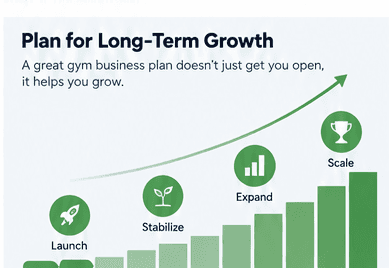
Your business plan is full of assumptions before launch.
After launch, you get data.
Use it.
Your original forecast might say:
- 60 leads per month
- 12 new members
- $165 average membership revenue
- 4% monthly cancellations
- $2,000 marketing spend
Six months later, compare that with reality.
Perhaps you are generating 90 leads but only eight enrollments.
That is probably not a lead-volume problem.
Perhaps enrollment is strong but cancellations are wiping out growth.
That points somewhere else.
Perhaps the 6 p.m. class is permanently full while midday sessions are almost empty.
Now capacity planning matters.
Perhaps personal training is producing twice the revenue you expected.
That may justify more attention.
A plan becomes useful when actual numbers are allowed to disagree with it.
Do not defend the spreadsheet.
Update it.
Where software fits into the business plan
Gym software should appear in the operations section because somebody has to manage memberships, payments, classes, attendance, communication, reporting, and member follow-up.
But do not write:
> We will use software to automate the gym.
That does not tell you much.
Decide what the system actually needs to do.
For example:
- take recurring membership payments
- manage plans
- schedule classes
- check members in
- track attendance
- identify declining engagement
- communicate with members
- track referrals
- report on retention and revenue
- reduce manual admin
Monstro-X gym management software brings membership management, payments, attendance, communication, reporting, referrals, automations, achievements, and community tools into one operating system for the gym.
The software should support the operating model you designed.
It should not be the operating model.
The best gym business plan forces uncomfortable questions early
A business plan is useful when it makes you change something.
Maybe the rent is too high.
Maybe the gym needs a higher price.
Maybe the schedule only supports 160 members when your financial target requires 230.
Maybe your original staffing model leaves you coaching every session.
Maybe the proposed location looks impressive but the numbers are better in the less glamorous unit two streets away.
Maybe you do not need as much equipment on day one.
Maybe you need six more months of cash.
Those are good discoveries.
The cheapest time to discover a bad assumption is while it is still sitting in a spreadsheet.
Build the plan around the local market, member capacity, sales process, retention, costs, and cash.
Then keep updating it as the real business starts telling you what is actually true.

Sources & References
- Health & Fitness Association — 2026 U.S. Health & Fitness Consumer Report: Headline Trends
- Health & Fitness Association — 81 Million Americans Were Members of a Fitness Facility in 2025
- U.S. Small Business Administration — Plan Your Business
- U.S. Small Business Administration — Write Your Business Plan
- U.S. Small Business Administration — Break-Even Point
- Mindbody — Fitness Studio Business Plan Template
- PushPress — How to Create a Gym Business Plan in 6 Steps
- Gymdesk — How to Open a Gym: 11 Steps to Launch Your Fitness Business
- Wodify — Five Wodify Reports to Optimize Your Gym Business Plan